


 News
News
~772 words | 5 000 characters | Reading time: 4 minutes
Tears that bind and tears that divide – crying in a relationship
Although crying is a phenomenon known to all mankind, it is not known what role it plays in romantic relationships. Grant winner Adrianna Kaczuba-Kozic‘s research seeks to elucidate the relationship between types of emotional crying and subjectively perceived relationship quality in both partners.
INTRODUCTION | Each of us knows the feeling when drops of a salty mixture of water, mucus and proteins are secreted from the lacrimal glands, which travel through the ducts above the upper eyelid and flow into the nasolacrimal duct. Each of us is familiar with crying. According to scientists, crying is just one type of tearing – the one that does not result from the presence of eye irritants, and which is caused by emotional states: sadness, joy, anger, feelings of helplessness. They call it emotional crying. Psychologists ask what function it serves, especially in adults. They say it strengthens social ties. After all, a crying person evokes empathy and sympathy. But does it work the same in every relationship – including romantic ones?
 “There is as yet no direct evidence on the role of emotional crying in romantic relationships.” – writes Adrianna Kaczuba-Kozic, M.A., an assistant professor at the Institute of Psychology at the University of Lodz and winner of a grant in the PSPS member-junior competition (pictured left). – “This project is meant to fill a gap.”
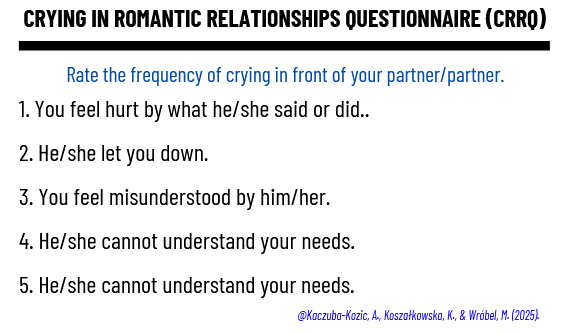
Before this could happen, however, it was first necessary to create a tool to study the types of emotional crying in romantic relationships. The Crying in Romantic Relationships Questionnaire (CRRQ), created by Kaczuba-Kozic, M.A., is an inventory of 25 questions in which subjects refer to situations described in statements (called items), rating on a scale the frequency of crying (in them) with their partner/partner. Sample items can be found in the graphic on the right.
With the help of the CRRQ, 5 types of crying were distinguished: discomfort in the relationship, comfort in the relationship, concern for others, emotion regulation, and manipulation, which occur depending on the situation: whether you cry because of being invisible to your partner, whether you both move to tears at the movies, or maybe you suspect that your partner is out to push his or her opinion by crying.
It might seem that the role of crying is thoroughly and extensively researched as a social glue, because almost everyone cries – or at least everyone of us has cried at some point. But is this also the case in romantic relationships? The winning project examines the relationship between crying type and relationship quality.
METODOLOGY | In the study, the independent variable is the type of crying, which will be examined with the CRRQ tool. The dependent variable is relationship quality understood as subjective satisfaction. In the study it will be measured multidimensionally: the Relationship Satisfaction Scale (CSI, Funk, Rogge, 2007; in the Polish adaptation: Stawska, 2011) and also a shortened version of the Trifactor Love Scale (TLS-15; Kowal et al., 2024), which measures the intensity of three indicators of relationship quality called in Sternberg’s conception – the components of love(intimacy, commitment and passion).
HYPOTHESES | The study is to verify the following research hypotheses relating type of crying to lower or higher quality of relationship:
1. Discomfort crying ↑ Relationship quality ↓
➡️ If you cry because you feel misunderstood, that your partner is unable to see your needs, the perceived quality of the relationship is low. Here crying is a response to discomfort in the relationship.
2. Comfort crying ↑ Relationship quality ↑
➡️ If there are tears of pride in your eyes because of your partner’s success or you cry because of a nice gesture from him/her, it goes hand in hand with a higher quality relationship.
3. Other-oriented crying ↑ Relationship quality ↑
➡️ What if you cry in front of your partner/partner, seeing the suffering of other beings – people or animals? Being able to discover your sensitivity is associated with perceiving/feeling a higher quality of relationship.
4. Emotion regulation ↑ Relationship quality ↑
➡️ When crying after an argument with your partner/partner allows you to release accumulated emotions, or when you cry while confiding in him/her about your difficulties, then a higher level of quality is observed in such a relationship.
5. Manipulation crying ↑ Relationship quality ↓
➡️ If the purpose of crying is to get your partner to change his behavior, this type of crying lowers the quality of the relationship. In other words, if you cry to make your partner not go to a party, the quality of your relationship is low.
PARTICIPANTS | The participants of the study are adults in heterosexual relationships of more than 1 year. The study includes N = 230 couples, i.e., both partners from a relationship. Participants will be financially rewarded from a PSPS grant. The survey process is likely to start in the third quarter of 2025.
The results of the survey will be expected early next year.
In addition to the grant winner in a leading role, the project involves Dr. Karolina Koszałkowska and Dr. Monika Wróbel – both from the Institute of Psychology of the University of Lodz.
In this post also used:
- Grant submission by Adrianna Kaczuba-Kozic.
- Kaczuba-Kozic, A., Koszałkowska, K., & Wróbel, M. (2025). Tears for better, for worse: Development and validation of the Crying in Romantic Relationships Questionnaire. Manuscript in preparation.
- Vingerhoets AJJM, Bylsma LM. The Riddle of Human Emotional Crying: A Challenge for Emotion Researchers. Emot Rev. 2016 Jul;8(3):207-217. doi: 10.1177/1754073915586226. Epub 2015 May 28. PMID: 30854025; PMCID: PMC6402489.
- The illustration on the home page (i.e., the highlight image) was generated by artificial intelligence (Microsoft Copilot / DALLE).
Views: 206