


 News
News
~ 943 words | ~ 6 214 characters | Reading time: 4.5 minutes
When contempt drives hate speech: The role of stereotype content
Hate speech (HS) is a form of verbal aggression that includes insults and statements inciting hatred or violence against individuals or groups based on their sexual orientation, religion, ethnicity, or other characteristics. Some groups experience hate speech online significantly more often than others. However, it is still unclear why this occurs and what motivates people to produce hateful content. This issue was examined in a study conducted by the PSPS Treasurer, Dr. Wiktor Soral, Maciej Bieńkowski, and PSPS regular member Dr. hab. Michał Bilewicz from the University of Warsaw.
 Wiktor Soral
  Maciej Bieńkowski
 Michał Bilewicz
INTRODUCTION | According to the stereotype content model, people perceive groups other than their own along two key dimensions: coldness-warmth and incompetence-competence. The way a group’s stereotype is shaped determines how that group is treated. For instance, members of groups perceived as cold more often experience active harm—they are insulted, threatened, or attacked. In turn, people who belong to groups perceived as incompetent mainly encounter passive harm — they are avoided, overlooked, or excluded. Since hate speech involves direct verbal attacks and linguistic degradation, this model would suggest that it is primarily directed at groups perceived as lacking warmth, but not necessarily as incompetent. At the same time, research findings indicate that hate speech is often directed at low-status groups perceived as lacking competence, and it is precisely toward such groups that contempt is most frequently reported. The significance of stereotype content and the role of contempt in predicting the use of hate speech toward specific groups were examined in a study by Dr. Wiktor Soral, Maciej Bieńkowski, and Dr. hab. Michał Bilewicz.
HYPOTHESES | The researchers hypothesized that hate speech would be more frequently directed at groups perceived as lacking competence than at those lacking warmth. Furthermore, they expected that contempt would mediate the relationship between perceived competence and the use of hate speech.
METHOD | The study was conducted in Germany (N = 1,042), the United Kingdom (N = 1,007), and Poland (N = 1,086) among individuals who did not identify as belonging to ethnic minority groups. Participants answered questions regarding stereotypes, emotions, and their propensity to use hate speech toward the dominant immigrant group in their country (in Germany—Turks, in the United Kingdom – Poles, in Poland—Ukrainians), as well as toward Jews and welfare recipients. For each target group, the content of their stereotypes, levels of contempt, and the frequency of hate speech directed at them were assessed. In the analysis of motivation for using hate speech and the mediating role of contempt, the groups were analyzed jointly.
Group competence stereotypes – competence stereotypes were measured using two items developed by Cuddy et al. (2007), e.g., Do people like you think Jewish people are competent/capable?
Group warmth stereotypes – warmth stereotypes were also assessed using two items from Cuddy et al. (2007), e.g., Do people like you think Ukrainians are warm/friendly?
Contempt felt toward a group – the level of contempt toward a given group was measured with the question: To what extent do people like you feel the following emotion toward welfare recipients: contempt?
Declared use of hate speech participants were shown three examples of hate speech directed at each target group and then answered questions about their own use of hate speech toward that group, e.g., Do you often write or speak using similar statements about Poles?
RESULTS | Group stereotypes and hate speech. As hypothesized, at the group level, it was primarily perceived competence that was associated with a higher risk of hate speech being directed at a given group. Figure 1 presents the relationship between stereotype content and the intensity of hate speech directed at individual groups. The larger the circle in the figure, the higher the intensity of hate speech—a value of 0 indicates the mean level across the sample, while positive and negative values indicate levels above and below this mean, respectively.
Figure 1. Group competence and warmth stereotypes and the use of hate speech.
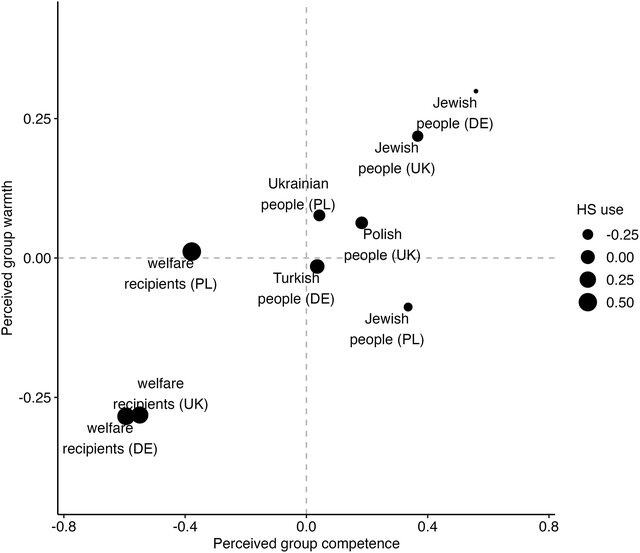
Immigrant groups were perceived neutrally in all countries studied. Jewish people were perceived most positively across all groups on both dimensions in Germany and the United Kingdom. In Poland, they were seen as competent but rather cold. Among all groups, welfare recipients were perceived most negatively on both dimensions in Germany and the United Kingdom, whereas their perception was somewhat less negative in Poland. In the Polish sample, welfare recipients were viewed as low in competence but neutral in terms of warmth.
The mediating role of contempt in the relationship between stereotypes and hate speech. Participants who endorsed stereotypes of low competence and low warmth for the target groups reported stronger feelings of contempt toward those groups and more frequent use of hate speech directed at them (Figure 2). As expected, perceived group competence was more strongly associated with the level of felt contempt than perceived warmth. Indirectly, through contempt, both the perceived competence and warmth of a group were linked to more frequent self-reported use of hate speech toward that group. At the same time, the indirect effect of competence stereotypes on self-reported hate speech was stronger than the indirect effect of warmth stereotypes
Figure 2. The relationship between stereotype content and levels of contempt toward target groups and the use of hate speech.
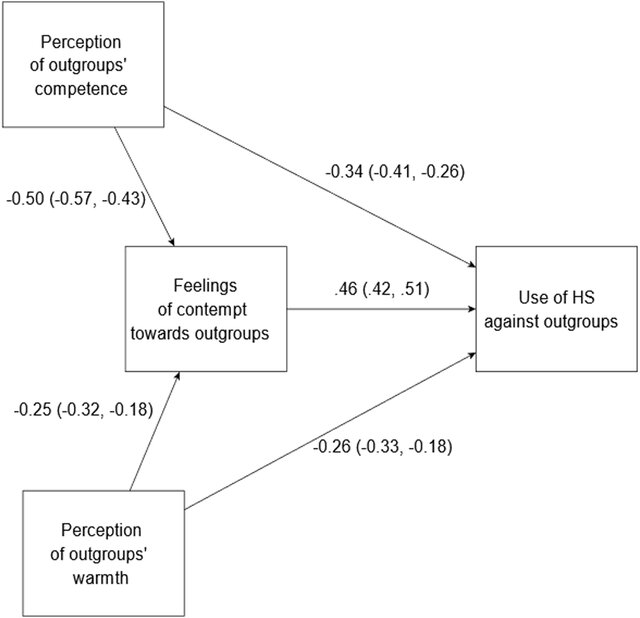
SUMMARY | The presented study indicated that groups perceived as less competent and, to a lesser extent, as less warm, more frequently experience hate speech. Contrary to the assumptions of the stereotype content model, which posits that low competence leads to contempt only in combination with low warmth, the results suggest that the perception of low competence alone is associated with greater contempt and more frequent use of hate speech.
Furthermore, holding a contemptuous stereotype toward a given group, related to perceiving it as low in competence, may predict the use of hate speech against that group. These findings are consistent with the conceptualization of contempt as an emotion associated with a lack of respect and perceiving others as inferior.

Image by deagreez from Adobe Stock
Views: 33