


 News
News
~ 747 words | ~ 5 401 characters | Reading time: 3.5 minutes
Exceptional Non-Believers: Collective Narcissism Among Agnostics and Atheists
Collective narcissism is characterized by a strong and uncritical attachment to one’s group, which holds the status of a social group, as well as a strong need for that group to be recognized by others. We may identify with many social groups related, for example, to our place of residence, profession, or religion. However, being a “non-believer” does not merely mean a lack of religious identification, but it may also mean identification with the group of agnostics or atheists. The Vice President of the PSPS, Prof. Magdalena Żemojtel-Piotrowska (Cardinal Stefan Wyszynski University), together with an international research team, analysed collective narcissism among agnostics and atheists in 77 countries.

INTRODUCTION | Many studies focus on religiosity—its various dimensions, denominational differences, and their significance for believers. Non-believers are often classified simply as people “without faith” and thus assumed to lack identity components related to the broadly understood sphere of spirituality and life values. However, identifying as a member of the agnostic or atheist group can also be a source of belonging, meaning, and social bonds, just like identification with any other social group. A lack of recognition of this group by members of the broader society within a given country may, in turn, contribute to strengthening collective narcissism among individuals who identify as agnostics and atheists. In her research, Prof. Magdalena Żemojtel-Piotrowska focused on two components of collective narcissism—agency, reflecting beliefs about the group’s exceptional effectiveness, and communion, emphasizing the group’s exceptional morality.
HYPOTHESES | It was expected that levels of collective narcissism would be lower among agnostics and atheists in secular countries compared to religious countries, as non-believers are more socially accepted in secular contexts. Additionally, it was hypothesized that a sense of exceptional effectiveness (agency) would be more important for atheists than for agnostics. Whereas a sense of exceptional morality (communion) would be more important for agnostics than for atheists.
METHOD | The research sample included 3,570 individuals who did not report any religious affiliation, including 1,227 who self-identified as agnostics and 2,343 as atheists. Participants were grouped according to the dominant religion in their country: Buddhism, Hinduism, Islam, Judaism, and Christianity (divided into Catholicism, Orthodoxy, and Protestantism). The study was conducted in 77 countries. The following were classified as secular countries (where non-believers constitute the largest proportion of the population): the Czech Republic, China, Estonia, North and South Korea, Switzerland, and Vietnam.
Social identification – from the available categories of religious affiliation, participants indicated their identification as agnostics or atheists.
Agency – the agentic aspect of collective narcissism was measured using 8 items from the Collective Narcissism Scale developed by Golec de Zavala et al. (2009), e.g., Not many people seem to fully understand the importance of agnostics/atheists.
Communion – the communal aspect of collective narcissism was measured using 7 items from
the Communal Collective Narcissism Scale by Żemojtel-Piotrowska and colleagues (2021),
e.g., Agnostics/atheists always fights for the poor and oppressed.
RESULTS | Agnostics and atheists from secular countries reported lower levels of collective narcissism (especially its agentic form) compared to non-believers from religious countries. Moreover, in both groups, higher scores were obtained for communal rather than agentic collective narcissism. Being an agnostic or an atheist was expressed through both agentic and communal forms of collective narcissism, as indicated by the successful replication of the measurement models of both scales across all analysed religion-based groups.
Figure 1. Agentic and communal collective narcissism among agnostics across countries with different religious heritages.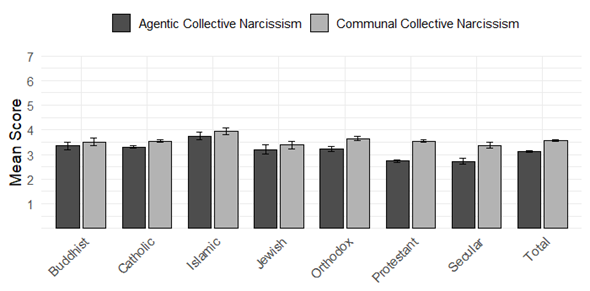
Figure 2. Agentic and communal collective narcissism among atheists across countries with different religious heritages.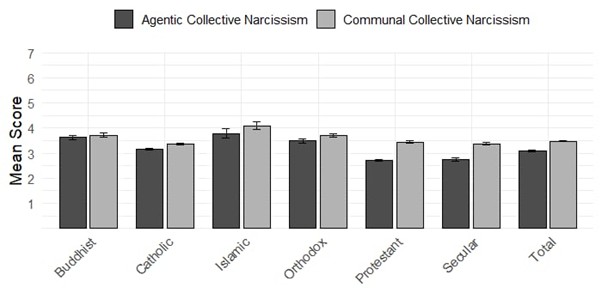
Agency. Only in Catholic countries was a higher level of agentic collective narcissism, i.e., a sense of exceptional effectiveness and agency, observed among atheists compared to agnostics. This relationship was not confirmed in the overall sample.
Communion. Agnostics displayed higher levels of communal collective narcissism, i.e., a sense of exceptional morality, also only in Catholic countries. As with agency, no statistically significant differences were found in the overall sample.
SUMMARY | The presented cross-cultural study showed that agnostics and atheists, similarly to believers, may exhibit narcissistic attachment to their in-group, both in the form of agentic and communal collective narcissism. As predicted, in secular countries the collective narcissism of non-believers was lower than in countries where non-believers constituted a minority, regardless of those countries’ religious traditions. This result is consistent with the hypothesis that the lack of recognition of one’s ingroup by the dominant majority provides a basis for the development of a defensive, narcissistic identification with the ingroup.

Image by Worawut from Adobe Stock
Views: 11