


 News
News
~1 000 words | 7 661 characters | Reading time: 4 minutes
Reclaiming the word – does the offensiveness of an insult depend on context still causing shock?
The offensiveness of words can be changed – the best example being the word “queer” – through a process called reclaiming. It involves a conscious effort by those affected by the insult. The process itself is multidimensional. Does the context change the offensive potential of the word? Is the reclaimed word further perceived as a manifestation of hate speech,” ask Dominik Puchała, Michał Bilewicz i Aleksandra Świderska, authors of the text 🔓“Reclaiming Derogatory Language: Self-Reports and Interbeat Intervals” published in Journal of Language and Social Psychology.
INTRODUCTION | They say that the most powerful missile in the world is the Russian RS – 28 Sarmat – a heavy, carrying a nightmarish payload of 10 tons, long-range jet missile, capable of destroying a sizable chunk of a signle country – or even an entire country like France. Actually, that’s not true. The most powerful missile that mankind has invented is the word. “Faggot,” ‘faggot,’ ‘pederast,’ ‘sodomite,’ ‘nigger,’ ‘cunt’ – these are the projectiles that hurt the deepest, oozing poison many years after they are uttered. A psychologist would say they stigmatize.
The good news is that verbal missiles can be defused. Words change meaning – even those that happen to be nasty insults. That’s what happened to the insulting word “woman” in the 15th century – after all, “kob” means “pigsty” – constituting a term for a promiscuous white-headed woman. The word in its new meaning came into use in the 17th century and today women are proud to be women.
Queer – The word comes from the Germanic languages, where “twerh” meant “oblique.” Although the meaning of “homosexual” in a pejorative sense has been recorded by dictionaries since the 1920s, and the negative overtones of the word “queer” had already acquired before that – as a synonym for the word “suspicious.” In the ’80s of the 21st century, the LBGT+ community began the process of reclaiming the word, and now ‘queer’ is seen as a neutral word (in most cases).
The process of changing the meaning of a word does not have to take decades at all, it may be accelerated and even controlled. When, as a result of the actions of a community defined by an insulting word, it changes its tone to at least neutral, it can be said that the word has undergone a process called reclaiming.
How is it progressing? Certainly gradually. First, individuals from the community begin to use the term to refer to themselves, making it a point of pride, e.g., “I’m queer and I’m good with it.” Released from its original meaning, the word spills over to other individuals. After time, the community itself begins to identify with the term. The final level of adoption is reached when those outside the community recognize the term in its changed meaning. Impossible? Successful takeover has been achieved by the words “queer” and “dyke,” and in Polish the candidates are “faggot,” “faggot” and “lesba.”
The problem is that the reclaiming process doesn’t happen overnight – it is a complex and multidimensional phenomenon. Can the insult depend on the context? Does the word: “faggot” or “faggot” hurt differently when it falls in the context of the Gay Pride (PR) or the March for Life and Family (MLF)? Puchała, Bilewicz and Świderska examine whether the mere suggestion of a message sender’s association with the LGBT+ community will cause his or her statements to be judged less offensive than those of the speaker in other contexts. However, they don’t just stop at examining statements about the offensiveness of a word.
“Qualitative research has shown that acquired hate speech, despite being judged less offensive than traditional hate speech, still causes shock.” – Dominik Puchała explains in an interview on the text.
It was this shock that the study was looking for, hence the psychophysiological measurement appeared alongside self-descriptive measures. Well, the lips can lie, the heart – never.
A study by Puchała, Bilewicz i Świderska (2025)
PREDICTIONS | The researchers predicted that:
- CONTEXT-DEPENDENCY — The offensiveness of the words “faggot,” “nancy” will be lower when uttered in the context of the Gay Pridethan when uttered during the March for Life and Family – but this effect will occur only among gay men. Heterosexual men, the researchers surmise, will evaluate words the same way regardless of the context.
- RECLAIMED WORD AS A HATE SPEECH — If the words taken over are perceived as hate speech, hearing them, participants should make their heart rate rise – regardless of the context. If the words “faggot” and “nancy”, however, depend on the context, then appearing during the Gay Pride should not cause the heart rate to rise, unlike the March for Life and Family. This hypothesis is a translation of the former into the language of heartbeats.
THE EXPERIMENT | Participants took the test in a soundproofed room, equipped with computer equipment, and electrodes of a device that measures heart activity, known as an electrocardiogram (ECG), were attached to their chests. In this case, it will act as a variograph – a physiological measure of the offensiveness of words, which can be independent of what the test person declares. As proven earlier, insults cause stress and an accelerated heartbeat.
Participants listened to 14 recordings containing statements of two types – offensive ones, e.g. “Those faggots haven’t gotten here yet.” and neutral ones, “Well we’ve been waiting a while for that gay couple.” It’s worth noting here that previous studies on this topic have examined offensiveness using single words. Here, in Puchała and colleagues’ study, insults were woven into entire sentences.
Context was manipulated by stating that the statements came from recordings made during the Gay Pride (GR) or the March for Life and Family (MLF). Listening to each recording ended with an indication on a scale from 1 to 7 of how offensive the statement heard was.
THE PARTICIPANTS | Only men, N = 103, aged 18 to 56, participated in the study. Half of the participants had higher education. More than 80% of them resided in large cities with populations over 500,000. The ratio of gay men to straight men was 50:50.
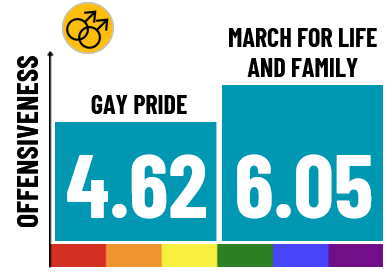
THE RESULTS| Are the word “faggot” and “nancy” in the process of taking over? Do the words: “faggot” and “nancy” have the status of hate speech? According to the first hypothesis, when uttered in the context of PR, they are considered less offensive than in the context of the IRS.
The mean (M, ang. mean) offensiveness of these words was lower (M = 4,62) when they were uttered during the Gay Pride than when they appeared at the March for Life and Family (M = 6,05).
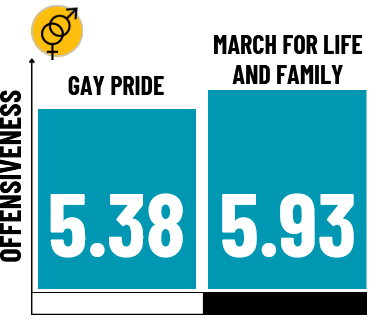
Interestingly – and partially contradicting the hypothesis – a similar effect was observed in heterosexual men. They, too, when hearing statements containing “faggot,” “faggot,” found these words less offensive in the context of the Gay Pride. The mean offensiveness of these words was also lower when they were uttered during the Gay Pride (M = 5,38) than when they appeared at the March for Life and Family (M = 5,93).
Note that less does not mean not at all. Respondents still found them offensive. The full success of taking on the meaning of words could be proclaimed if the words were not offensive to either gay or straight men.
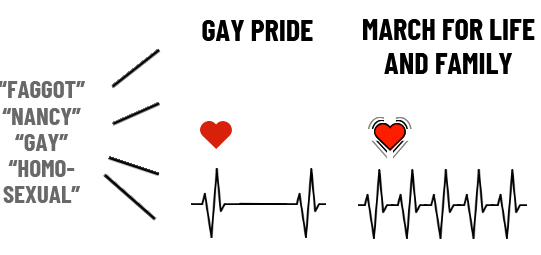 That’s not all. An electrocardiogram showed even more interesting things. Although the subjects found “faggot” and “faggot” offensive, when hearing these words, surprisingly, they showed no symptoms of stress and accelerated heart rate – both gay and straight men – compared to neutral words. The only factor that caused differences in heart rate was which event the participants were listening to the recordings from. Participants’ heart rates were slower when they listened to the PR recordings than when they listened to the IWD recordings. Regardless of sexual orientation, regardless of the type of speech (insult vs. neutral term).
It appears that conclusions from self-report measures are different from psychophysiological observations. How do the researchers explain this? Emotions evoked by the nature of the gathering. The Gay Pride has more friendly connotations than the March for Life and Family.
In the case of psychophysiology, we can say that what is said (an insult or a simple neutral word) has greater significance than the context (Gay Pride vs. March for Life and Family) – adds Dominik Puchała.
TAKE HOME MESSAGE | The study shows that under favorable circumstances, the offensive potential of the words “faggot” and “nancy” decreases. The process of taking over these words has already begun, but it should be remembered that they still have an offensive status and are punishable by a fine for use in public spaces.
Taking over is not so easy and pleasant – especially for the person actively involved in the process. Note that the blade of the insult must first be directed by the transferee against himself. “My other research shows that the consequences of exposure to acquired language are sometimes very similar to the consequences of exposure to traditional hate speech.” – Puchala says. What psychological effects this will have on the transferees – further studies the researcher is working on will show.
In this post also used:
- Narodowe Centrum Kultury (n/d). Być kobietą, być kobietą. Uzyskane z: https://nck.pl/projekty-kulturalne/projekty/ojczysty-dodaj-do-ulubionych/ciekawostki-jezykowe/byc-kobieta-byc-kobieta-
- Bieńko, M. (2019). „Pedał” i „lesba” jako społeczne pojęcia życia codziennego. Heteroseksualne uprzedzenia językowe dotyczące gejów i lesbijek. InterAlia: Pismo poświęcone studiom queer, 14, 86-102.
- Dyszak, A. (2013). Nazwy mężczyzn homoseksualnych we współczesnym języku polskim. Studia Językoznawcze. Synchroniczne i diachroniczne aspekty badań polszczyzny.
- Harper, D. (n.d.). Etymology of queer. Online Etymology Dictionary. Retrieved March 6, 2025, from https://www.etymonline.com/word/queer
- Narodowe Centrum Kultury (n/d). Być kobietą, być kobietą. Uzyskane z: https://nck.pl/projekty-kulturalne/projekty/ojczysty-dodaj-do-ulubionych/ciekawostki-jezykowe/byc-kobieta-byc-kobieta-
- Puchała, D., Bilewicz, M., & Świderska, A. (2025). “A red alert appears”. Ambivalence of the reclaimed hate speech in a hate-saturated environment. Journal of Homosexuality, 1-23. https://dx.doi.org/10.1080/00918369.2025.2469581
- Images by Lili
- The photo of prof. Bilewicz taken from Wikipedia site

DOMINIK PUCHAŁA |
PhD student at the Center for Research on Prejudice at the University of Warsaw. He is affiliated with the Gabriel Narutowicz Institute of Political Thought. He works on emancipatory strategies, hate speech and far-right movements. Junior member of the PSPS association.


 MICHAŁ BILEWICZ |
PhD. in social sciences, associate professor at the University of Warsaw, Center for Research on Prejudice. Member of the PSPS association.

ALEKSANDRA ŚWIDERSKA |
PhD in social sciences, a researcher at the University of Warsaw, head of the UW Center for Research on Prejudice.

Views: 22