


 News
News
~ 1 083 words| ~ 6 068 characters | Reading time: 5 minutes
From interaction to donation: How mimicry shapes prosocial decision-making
Humans have a natural tendency to spontaneously align with their conversation partners—we mirror their gestures, speech patterns, and pace of speaking. Previous research has shown that such mimicry is associated with more positive perceptions of the other person. But do the benefits of being mimicked remain limited only to the interaction with the person who imitates us? Or do the positive effects of mimicry “spill over” more broadly and influence our behavior toward others? These questions were addressed by the PSPS Secretary General, Dr. Paweł Muniak (SWPS University), Prof. Oliver Genschow (Leuphana University Lüneburg), and regular members of PSPS from SWPS University—Prof. Dariusz Doliński, Prof. Tomasz Grzyb, and Prof. Wojciech Kulesza.


INTRODUCTION | Mimicry of other people’s behavior has long been a topic of interest in social psychology. Research has shown that individuals who are mimicked are perceived as more likable than those who are not. Moreover, the mimicking person is often judged as more competent, persuasive, and trustworthy. This positive impression translates into behavior as well—people are more willing to help those who have mimicked them. However, most research has focused on the dyadic relationship between the mimicker and the mimicked individual. Some findings suggest a possible “spillover” of this effect to third parties not directly involved in the interaction, but these studies are limited by important methodological shortcomings, primarily small sample sizes and artificial laboratory settings rather than natural social contexts. Additionally, even in these few studies, an alternative explanation has not been ruled out: rather than mimicry increasing prosociality, it may be the absence of mimicry that reduces it. A team of researchers led by Dr. Paweł Muniak therefore examined the relationship between mimicry and social behavior using data from experiments designed to address key limitations of previous research.
HYPOTHESES | The authors expected that individuals who had previously been mimicked would show more prosocial behavior, operationalized as financial donations, compared to individuals who had not been mimicked. In addition, it was hypothesized that the positive effect of mimicry, namely, increased willingness to donate, would not be limited only to the mimicking person but would also be observed in interactions with a person unrelated to the initial interaction.
EXPERIMENT 1 | The study (N = 216) was conducted in a park in one of the large Polish cities. Randomly, one of two female experimenters or one of two male experimenters approached each person walking alone in the park. After establishing contact, participants were asked to take part in a five-minute interview on online education during the COVID-19 pandemic. Participants were then asked to make a donation to a charity supporting the development of children and adolescents in Poland. They made real donations, freely deciding the amount, with no default option or suggestion regarding the size of the contribution.
During the interview, participants were:
(1) mimicked – the experimenter mimicked the participants’ tone of voice, raising or lowering their voice and/or adopting a happy, sad, or neutral tone. In addition, the experimenter mimicked the content of participants’ statements by repeating their structure and word order,
(2) or assigned to a control condition – the experimenter expressed understanding using only the words “yes” and “I understand.”
The donation request was made:
(3) either by the same person who conducted the interview,
(4) or by an independent person wearing a visible logo of a charity supporting the development of children and adolescents in Poland.
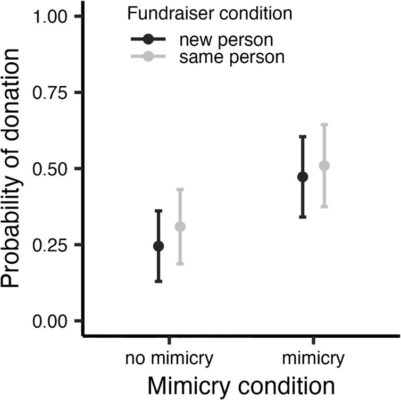
RESULTS | Participants who had previously been mimicked during the interview were more likely to make a donation than those who were not mimicked (Figure 1). However, there was no effect of the person requesting the donation—participants donated similar amounts both to the interviewer and to an independent person. These findings support the existence of a “spillover” effect of mimicry beyond the interaction with the mimicking person.
Figure 1. Probability of donating as a function of mimicry and the person requesting the donation.
EXPERIMENT 2 | Experiment 1 included two conditions: mimicry or no mimicry during the interview. Given that mimicry is a natural behavior, it is possible that its absence may create discomfort for participants. To rule out the possibility that it is the lack of mimicry, rather than mimicry itself, that drives prosocial behavior, a second field experiment was conducted.
Study 2 (N = 244) was conducted in the same city in Poland, but in a different park. As in Experiment 1, the experimenter conducted a five-minute interview, asking questions about online education during the COVID-19 pandemic. As before, some participants were mimicked (1), while others were not mimicked, and the interviewer only expressed understanding (2). To ensure that the absence of mimicry did not reduce participants’ mood, which could in turn influence subsequent prosocial behavior, participants in both conditions completed a four-item mood questionnaire (Bocian et al., 2018; Wojciszke & Baryła, 2005).
In this study, the donation request was always made by an independent person who had not taken part in the interview.
Unlike Experiment 1, an additional control group (3) was included, in which donation requests were also made to individuals who had not previously participated in the interview.
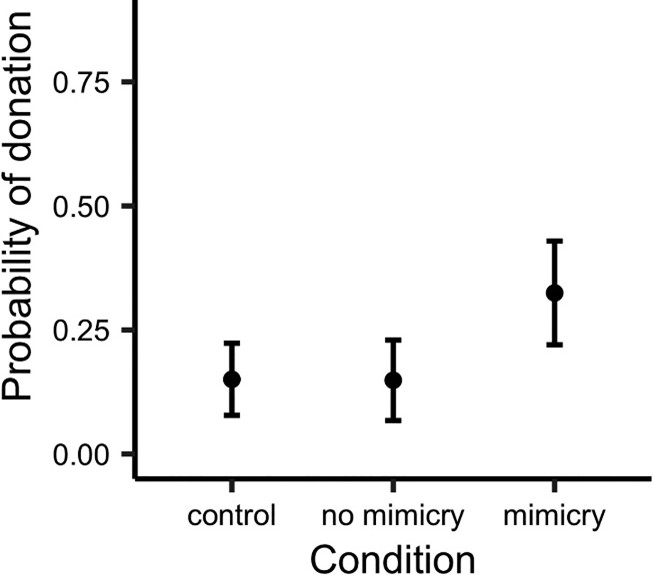
RESULTS | In this experiment, participants who had been mimicked were more likely to agree to donate than those who had not been mimicked or who had not previously taken part in the interview. However, no difference was found between the no-mimicry group and the control condition in terms of the likelihood of donating (Figure 2). In line with Study 1, no differences between groups were observed in the amount of donations.
Additionally, a mediation analysis was conducted to test the mediating role of mood in the relationship between mimicry (or its absence) during the interview and donation behavior. The analysis showed that positive mood partially explains the relationship between mimicry and prosocial behavior, supporting higher rates of donating.
Figure 2. Probability of donating as a function of experimental condition.
SUMMARY | The results of the two field experiments were consistent. Participants who had previously been mimicked were more likely to make a donation, regardless of whether the request was made by the mimicking person or by a third party. This indicates that mimicry increased general willingness to engage in prosocial behavior. At the same time, this effect did not translate into the amount donated—mimicked participants were more willing to help, but they did not give larger donations.
Previous research has suggested the importance of mood in the relationship between mimicry and prosocial behavior. Experiment 2 confirmed that positive mood plays a mediating role in this effect. This means that mimicry improves mood, and improved mood, in turn, increases helping behavior. These findings are therefore consistent with earlier evidence showing that positive mood increases the likelihood of helping others.

Image by Halfpoint from iStock
Views: 15