


 News
News
~ 1 184 words | ~ 7 315 characters | Reading time: 5.5 minutes
Attachment anxiety as a driver of status striving: Between relational insecurity and competition with same-sex others
The pursuit of high social status is a fundamental motive in human social behavior. Some individuals establish their position through competence and recognition from others, while others invest in visible symbols of success. Increasingly, the question arises whether these differences are due solely to social and economic factors or whether they also reflect deeper psychological mechanisms related to functioning in close relationships. This question is addressed by recent research conducted by
Prof. Agata Gąsiorowska (SWPS University in Wrocław, PSPS regular member), Dr. Michał Folwarczny (University of Galway), and Prof. Tobias Otterbring (University of Agder, KTH Royal Institute of Technology).
 Agata Gąsiorowska
 Michał Folwarczny
 Tobias Otterbring
INTRODUCTION | Individuals with an anxious attachment style live in a state of heightened relational vigilance. They fear rejection, seek reassurance of closeness, and tend to interpret the absence of clear signals from others as a threat. Relationships, rather than being a source of security, become a source of tension for them.
In contrast, individuals with an avoidant attachment style downplay their need for closeness, emphasize autonomy, and maintain emotional distance. In this context, Prof. Agata Gąsiorowska, Dr. Michał Folwarczny, and Prof. Tobias Otterbring advance a central thesis: for individuals with anxious attachment, status may serve
a compensatory function. If a sense of security cannot be achieved through relationships, it may instead be pursued through social position, recognition, and advantage over others. Competition with same-sex others
(i.e., intrasexual competition) becomes a way to gain an edge and strengthen one’s position, linking the need for emotional security with the pursuit of material goods and markers of high status.
Moreover, the pursuit of status may follow either a prestige-based or a dominance-based strategy. Prestige is associated with the demonstration of valued competencies, expertise, and prosocial behaviors, which require long-term investment and stable social relationships. Dominance, by contrast, is based on signaling control, power, or superiority, often through strength, assertiveness, or aggression. According to the authors, dominance represents a strategy that is particularly attractive to individuals with an anxious attachment style due to its speed and relative accessibility.
HYPOTHESES | The researchers hypothesized that attachment anxiety (but not attachment avoidance) would be positively associated with status striving. They further predicted that intrasexual competition (i.e., competition with same-sex others) would be the key mechanism underlying this relationship. It was also expected that the effect would be particularly pronounced for dominance-based rather than prestige-based strategies of gaining status and that it would be independent of participants’ gender.
PRE-TEST and STUDIES 1-3 | Correlational analyses
PRE-TEST | Initial evidence for the relationship between attachment style and status pursuit was obtained in
a pilot study conducted in Poland (N = 472). The study showed that attachment anxiety was associated with a higher general level of status striving, while the relationship for attachment avoidance was negative. This result was then subjected to more rigorous tests in subsequent studies.
STUDY 1 | Study 1, conducted in the United Kingdom (N = 551) and South Africa (N = 553), examined whether intrasexual competition mediates the relationship between attachment style and status striving through dominance or prestige.
The analyses revealed that attachment anxiety significantly predicted dominance-based status striving but was not associated with prestige-based status pursuit. Intrasexual competition mediated the relationship between attachment anxiety and dominance-based status pursuit (Figure 1).
Figure 1. Intrasexual competition as a mediator in the relationship between attachment styles and status-seeking strategies.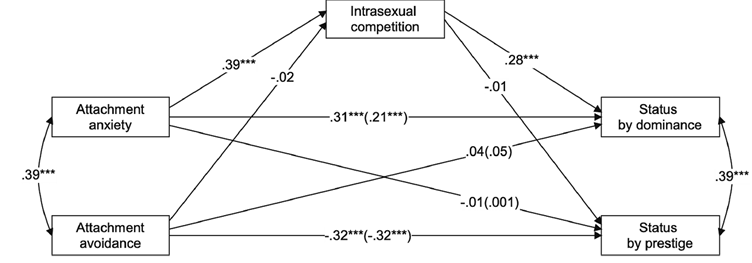
Most importantly, individuals with higher levels of attachment anxiety were more likely to perceive others as rivals and, consequently, to engage more strongly in dominance-based strategies.
No comparable relationships were observed for attachment avoidance. Notably, this pattern was remarkably consistent in both countries despite substantial socioeconomic differences between them.
STUDY 2 | Study 2 was conducted in the United Kingdom (N = 615) and aimed to examine whether the observed effect could be explained by other variables, such as materialism, intersexual competition, or socioeconomic status.
The results showed that although attachment anxiety was associated with higher levels of materialism, only intrasexual competition, not competition with the opposite sex, significantly mediated the relationship between anxiety and status striving. Moreover, this effect remained robust even after controlling for materialism as well as both objective and subjective socioeconomic status, indicating its relative independence from these factors.
STUDY 3 | In Study 3, conducted in Canada (N = 747), the authors examined whether the key mechanism underlying the observed effect was a general tendency toward competition or, more specifically, competition directed at same-sex others.
The results clearly indicated that although individuals with higher levels of attachment anxiety exhibited greater general competitiveness, it was intrasexual competition that emerged as the strongest and most specific mechanism explaining their status striving. This effect remained robust regardless of whether participants referred to romantic relationships or other close relationships, suggesting that the mechanism reflects a broader interpersonal pattern.
STUDIES 4-5 | Although the correlational findings were consistent, the next two experimental studies were especially important because they enabled causal inference.
STUDY 4 | In Study 4, conducted in the United States (N = 382), participants were first asked to rate the status associated with various car brands. Subsequently, their attachment state was experimentally manipulated by prompting them to recall relationship experiences characteristic of attachment anxiety or attachment avoidance.
The results showed that individuals in whom attachment anxiety was induced expressed a stronger desire for cars, but exclusively for those they perceived as
high-status. This effect was further linked to levels of intrasexual competition, which increased in the attachment anxiety condition and mediated the heightened desire for high-status cars.
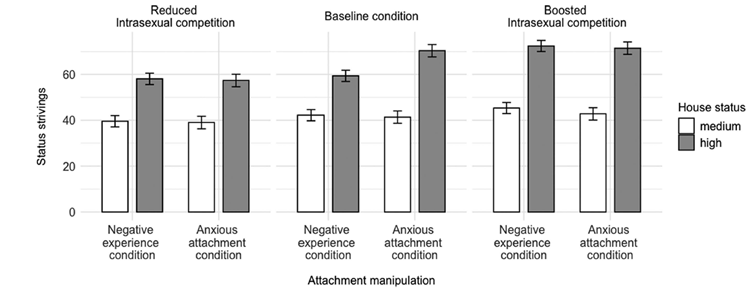
STUDY 5 | Even more compelling evidence was provided by Study 5, conducted on a large sample of 1,358 participants from the United States and the United Kingdom. In this experiment, both attachment anxiety and the level of intrasexual competition were experimentally manipulated.
The results showed that experimentally induced attachment anxiety increased status striving, but only with respect to high-status goods. Moreover, this effect was amplified under conditions of heightened competition and attenuated when competition was reduced, providing strong support for the proposed mechanism (Figure 2). This pattern was observed for both women and men.
Figure 2. Status striving as a function of attachment-style manipulation and intrasexual competition condition.
SUMMARY | The series of six studies conducted across five countries reveals a consistent psychological mechanism in which attachment anxiety fuels stronger status-seeking motives by heightening sensitivity to potential same-sex rivals. This rivalry, in turn, activates status-acquisition strategies, particularly those based on dominance and rapid signaling of social position. In this framework, status is not just a social or economic category but serves a regulatory function for fundamental relational needs.
These studies make an important contribution to social psychology by integrating attachment theory with research on status and consumer behavior. They show that the pursuit of status may be rooted in mechanisms that regulate one’s sense of security in interpersonal relationships and that social competition can be responsive to subtle cues of threat in the relational domain. At the same time, the authors acknowledge limitations in their work, such as the use of online samples and the exclusive focus on heterosexual participants, which restricts
the generalizability of the findings to other populations. Ultimately, the proposed model encourages a shift in perspective: rather than viewing status-seeking solely as a manifestation of ambition or materialism, it may also be understood as a response to a more fundamental question—one’s own worth and security in relation to others.

Image by deagreez from Adobe Stock
Views: 35