


 News
News
~ 1 001 words | ~ 6 197 characters | Reading time: 5 minutes
Dogmatism as a cognitive source of Right-Wing and Left-Wing Authoritarianism
Are authoritarian individuals always attached to specific political views, or is their way of thinking relatively stable while the content of their beliefs may change? In other words, does only right-wing authoritarianism exist, or is there also a left-wing counterpart? These questions were explored by PSPS regular member, Prof. Piotr Radkiewicz from Cardinal Stefan Wyszyński University, and Pamela Kozioł from the Polish Academy of Sciences.
 Piotr Radkiewicz
  Pamela Kozioł
INTRODUCTION | The concept of the authoritarian personality, introduced by Theodor Adorno in 1950, was intended to explain support for fascism by pointing to a cluster of traits including obedience to authority, attachment to traditional norms, and hostility toward those who deviate from them. In later research, Robert Altemeyer expanded this approach by proposing the concept of right-wing authoritarianism (RWA), emphasizing the particular role of traditionalism and submission to authority. At the same time, increasing attention has been paid to the existence of analogous tendencies on the political left (LWA), suggesting that authoritarianism may not be limited to one end of the political spectrum. From this perspective, what may matter most is not where an individual’s beliefs are located, but rather how extreme they are. Prof. Piotr Radkiewicz and Pamela Kozioł propose that an important factor explaining this process is dogmatism. Dogmatism can be understood as a relatively stable cognitive disposition characterized by rigidity of thinking, closed-mindedness toward new information, and a need for certainty. Ideology, in turn, constitutes the variable content of these beliefs. This distinction makes it possible to separate the cognitive and ideological components of authoritarianism and supports the concept of its polymorphic nature.
HYPOTHESES | The researchers predicted that authoritarianism has a polymorphic character—meaning that its cognitive structure (dogmatism) remains relatively stable, while the ideological content of beliefs may vary. Accordingly, they predicted that dogmatism would serve as a universal predictor of all forms of authoritarianism, regardless of their ideological content, whereas specific worldview-related content would additionally differentiate right-wing and left-wing authoritarianism. Furthermore, it was expected that dogmatism would be positively associated with various aspects of right-wing authoritarianism, while its relationship with left-wing authoritarianism might be more complex and become more apparent after controlling for opposing ideological orientations.
METHOD | The study was conducted on a sample of adult residents of Poland (N = 579) using a research panel. Participants assessed the extent to which they agreed with a series of statements taken from validated scales.
Left-wing authoritarianism (LWA) – was measured using 30 items from the scale developed by Costello et al. (2022), e.g., Deep down, just about all conservatives are racist, sexist, and homophobic.
Right-wing authoritarianism (RWA) – was measured using 12 items from the scale developed by Altemayer (1996), e.g., What our country really needs instead of more ‘civil rights’ is a good stiff dose of law and order.
Group authoritarianism (GA) – was assessed by asking participants to imagine a group operating according to ideal principles and then evaluate how such a group should be organized using 12 items from the scale developed by Stellmacher & Petzel (2005), e.g., A member of this group must, at all times, follow the rules that apply in this group.
Dogmatism – was assessed using 8 items from the scale developed by Stanovich & West (2007), e.g., Some beliefs are too important to abandon, no matter how good the arguments one can present.
Far-right beliefs – traditionalist-conservative right-wing beliefs adapted to the Polish context were measured using 10 items from the scale adapted by Wojciszke (2010), e.g., Poland should defend itself against the flood of patterns and customs that are alien to our national culture.
Far-left beliefs – the level of acceptance of a set of 14 radical progressive postulates and beliefs was assessed using the scale developed by Szumlewicz (2022), e.g., Acts of violence are justified if their goal is to stop climate change.
RESULTS | The results confirmed the assumption that the form and content of beliefs can be separated. Dogmatism turned out to be a significant predictor of right-wing, left-wing, and group authoritarianism. This suggests that individuals with high cognitive rigidity may adopt different belief systems, as long as these systems provide cognitive consistency and certainty.
Furthermore, left-wing authoritarianism was positively associated with far-left beliefs and negatively associated with far-right beliefs, whereas right-wing authoritarianism was positively associated with far-right beliefs and negatively associated with far-left beliefs. Group authoritarianism was not predicted by worldview-related variables.
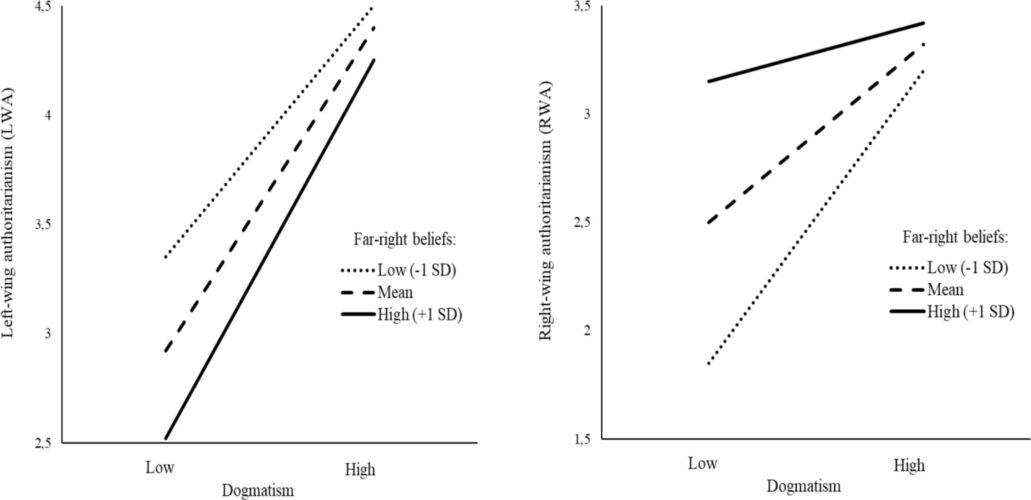
Significant interaction effects were also observed, with far-right beliefs acting as a moderator. The relationship between dogmatism and left-wing authoritarianism became stronger as endorsement of far-right beliefs increased, whereas the relationship between dogmatism and right-wing authoritarianism was strongest at low levels of far-right beliefs and weakened as these beliefs increased (see Figure 1). These findings indicate that the relationship between the cognitive component of authoritarianism and its ideological content is complex and goes beyond a simple matching effect.
Figure 1. Far-right beliefs as a moderator of the relationship between dogmatism and authoritarianism.
Dogmatism also proved to be a significant predictor of the non-ideological components of both right-wing and left-wing authoritarianism, indicating its universal character. At the same time, its association with ideological components was strong in the case of far-right beliefs but weak with regard to far-left beliefs. Additional analyses revealed a significant suppression effect, suggesting that the relationship between dogmatism and left-wing ideological content becomes apparent only after accounting for opposing worldview orientations.
SUMMARY | The findings indicate that authoritarianism has a polymorphic character, combining a relatively stable cognitive form with diverse ideological content. Dogmatism emerged as a universal predictor of the non-ideological components of authoritarianism, suggesting that cognitive rigidity constitutes its common foundation, independent of political orientation. At the same time, ideological content differentiates the direction and strength of these attitudes—right-wing and left-wing authoritarianism are associated with corresponding extreme beliefs while showing negative relationships with the opposing ideology.
The study demonstrates that distinguishing between the way people think (dogmatism) and the content of their beliefs (ideology) is crucial for understanding authoritarian attitudes. This perspective helps explain why similar psychological characteristics may lead to different worldviews. The findings support the hypothesis that the foundation of authoritarianism lies not in specific beliefs themselves, but in the way those beliefs are processed and maintained.

Photo by Makhbubakhon Ismatova from iStock
Views: 9