

'/%3E%3C/svg%3E)
 News
News
~ 885 words | ~ 5 413 characters | Reading time: 4 minutes
Small homeland, greater openness: The role of local identification in attitudes toward migrants
In public debate and scientific research, migration is most often analysed through the lens of national identity. Meanwhile, much less attention is paid to the role of identification with one’s “small homeland” (local community). Can attachment to the place where we live influence our attitudes toward migration to that place? This was one of the questions explored by Dr. Sabina Toruńczyk-Ruiz (PSPS Board member; University of Warsaw), Dr. Zuzanna Brunarska (University of Warsaw), and Dr. Aneta Piekut (University of Sheffield) in an international study conducted on representative samples of residents from six European countries.
 Sabina Toruńczyk-Ruiz
 Zuzanna Brunarska
 Aneta Piekut
INTRODUCTION | When we look at migration from the perspective of a country, we can distinguish between its two basic types: external (international) migration, when people arrive from other countries, and internal migration, when people move within the same country. Attitudes toward migrants are strongly shaped by who is perceived as belonging to “our” group and who is seen as an “outsider.” Previous research has focused primarily on national identity. From this perspective, migrants from other countries are clearly perceived as “outsiders,” whereas internal migrants, as fellow citizens, may be viewed as part of “us.” However, when we consider local identity, that is, identification with one’s locality of residence, both international migrants and newcomers from other parts of the country may be perceived as “outsiders.”
A large body of research suggests that strong national identification is associated with more negative attitudes toward international migrants. However, much less is known about the role of local identity and how these two levels of identification relate to attitudes toward internal migration. The study conducted by Dr. Sabina Toruńczyk-Ruiz, Dr. Zuzanna Brunarska, and Dr. Aneta Piekut intended to fill this gap in the literature.
HYPOTHESES | The researchers predicted that stronger national identification would be associated with more negative attitudes toward international migrants, while at the same time being linked to more positive attitudes toward internal migrants.
Given the mixed findings of previous studies, they assumed that the relationship between local identification and attitudes toward both groups of migrants could take either a positive or a negative form. Because individuals simultaneously identify at both the national and local levels, the interaction between these two identities was also expected to play an important role. Depending on whether local identity operates in a more exclusionary or a more inclusive way, it could either strengthen or weaken the influence of national identification on attitudes toward migrants.
METHOD | The analyses were conducted on nationally representative samples from six Central European countries: Austria, the Czech Republic, Germany, Hungary, Poland, and Slovakia. In total, the study included data from 10,765 participants drawn from the Central European Social Survey (2021–2022).
Attitudes toward internal and international immigration –were measured using 2 items for each group, where higher scores indicated more positive attitudes toward migrants, e.g., In your opinion, if people from other localities in [country] move to your locality, is it favorable or unfavorable for the economic situation in your locality?
Local identification – was measured using 4 items from the scale developed by Hernández et al. (2007), e.g., This locality is part of my identity.
National identification – was assessed using 6 items from the scale developed by Cameron et al. (2004), e.g., I have a lot in common with other [country nationals].
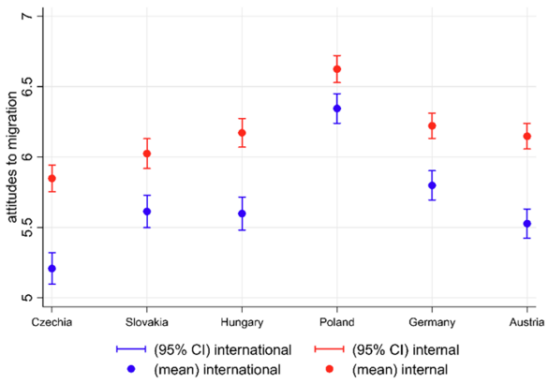
RESULTS | The analysis of attitudes toward migrants revealed that participants had generally positive attitudes toward both international and internal migrants. At the same time, attitudes toward internal migrants were more favourable than those toward migrants from other countries (see Figure 1). In cross-national comparisons, Poles displayed the most positive attitudes toward both groups of migrants. The analysis of identification levels showed that both national and local identification were above the midpoint of the scale. Moreover, local identification was stronger than national identification.
Figure 1. Attitudes toward international and internal migrants across the analysed countries.
As expected, stronger national identification was associated with more negative attitudes toward international migrants. This relationship was particularly evident in Germany and Hungary. A different pattern emerged in the Czech Republic, where stronger national identification was linked to more positive attitudes toward international migrants. In the remaining countries, the relationship was not statistically significant.
Contrary to the researchers’ predictions, national identification was not significantly associated with attitudes toward internal migrants. In contrast, local identification was linked to more positive attitudes toward both international and internal migrants. This pattern was observed both in the analysis including all countries combined and in the analyses conducted separately for each country.
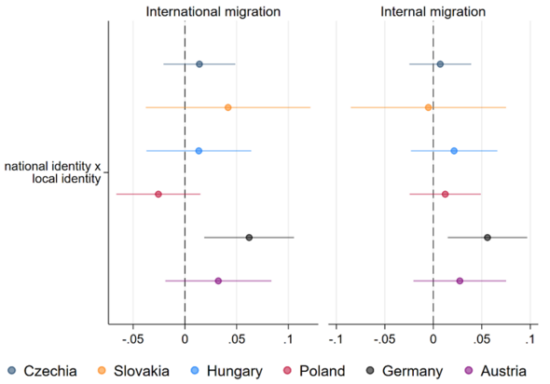
Local identification moderated the relationship between national identification and attitudes toward migration. However, in analyses conducted separately for each of the countries, the effect was statistically significant only in Germany (Figure 2). The results indicate that among those who strongly identified with their local community, the relationship between national identity and attitudes toward migration – both international and internal – was more positive.
Figure 2. The effect of the interaction between national and local identification on attitudes toward international and internal migration across the analysed countries.
SUMMARY | The results of the study show that not only national identification, but also local identification plays an important role in shaping attitudes toward migrants. While stronger national identification was associated with less favourable attitudes toward international migrants, identification with the local community consistently promoted more positive attitudes toward both international and internal migrants.
These findings suggest that identification with one’s “small homeland” may constitute an important resource that fosters openness and positive intergroup relations. Moreover, local identification may weaken the influence of more exclusionary forms of national identification on attitudes toward migration.
 Photo by Vaceslav Romanov from Adobe Stock
Views: 20