


 News
News
~ 1 001 words | ~ 6 197 characters | Reading time: 4 minutes
Remote, on-site, or hybrid—which work arrangement brings the greatest work satisfaction?
In the post-pandemic reality, some office workers have remained in a remote work setting, others have returned to the office, and some have opted for a hybrid model. Each of these arrangements has its own advantages and limitations, but which one is most conducive to job satisfaction? And which individual characteristics may be associated with different levels of job satisfaction in those modes? These questions are addressed in a study by PSPS regular member, Dr. Radosław Walczak from the University of Opole.

INTRODUCTION | Although three years have passed since the end of the COVID-19 pandemic, its effects remain clearly visible in many areas of social life, including the way work is performed. Until recently, office work was almost unequivocally associated with daily presence at the company’s premises. Today, for many people, everyday professional life looks different — tasks are carried out fully remotely or in a hybrid model combining home-based and on-site work. This change is not limited merely to the location where tasks are performed. Each work arrangement is associated with a different experience of professional functioning: a different level of autonomy, a different intensity of social contact, and different possibilities of separating work from private life. Naturally, this raises the question of whether the way work is performed influences work satisfaction levels. However, it is difficult to expect that the answer depends solely on work organization. The characteristics of the employee themselves may be equally important.
In his study, Dr. Radosław Walczak focused on two perspectives that may help explain the relationship between work arrangement and work satisfaction. The first concerns basic psychological needs, namely autonomy, competence, and relatedness. Whether work allows individuals to act independently, provides a sense of effectiveness, and enables them to maintain connections with other people may be of key importance for employee well-being. Autonomy is associated with a sense of influence and freedom of action, competence with the belief in one’s own effectiveness, and relatedness with the need to be a part of relationships and belonging to a community. The second perspective is the core self-evaluations, understood as a relatively stable psychological trait related to how a person perceives themselves—their own worth, agency, effectiveness, and sense of control over their own lives. Previous research shows that individuals with a more positive self-view are more likely to evaluate their work as more satisfying and better aligned with their needs.
HYPOTHESES | The author predicted that individuals working remotely would show higher levels of satisfaction with the needs for autonomy and competence, as well as higher levels of work satisfaction, while at the same time reporting lower levels of satisfaction with the need for relatedness compared to individuals working on-site. It was also expected that satisfaction of basic psychological needs would mediate the relationship between work arrangement and work satisfaction. Additionally, it was assumed that core self-evaluations would be associated with work satisfaction through the satisfaction of basic psychological needs.
METHOD | The study included 612 employed individuals. Three groups were distinguished: (1) on-site workers (N = 372), (2) hybrid workers (N = 166), combining on-site and remote work, and (3) remote workers (N = 74).
Basic psychological needs – measured using a scale developed by Chen et al. (2015) in the Polish adaptation by Szulawski et al. (2021). The scale included separate subscales measuring autonomy (4 items, e.g., I feel that my decisions on my job reflect what I really want.), competence (4 items, e.g., At work, I feel capable at what I do.), and relatedness (4 items, e.g., I feel connected with people who care for me at work, and for whom I care at work.).
Core self-evaluation – measured using a 12-item questionnaire developed by Judge et al. (2003) in the Polish adaptation by Walczak & Derbis (2017), e.g., I am confident I get the success I deserve in life.
Work satisfaction – assessed using 4 items from a scale developed by Pejtersen (2010) in the Polish adaptation by Baka (2019), e.g., Regarding your work in general. How pleased are you with your job as a whole, everything taken into consideration?
RESULTS | As predicted, both remote and hybrid workers reported higher levels of autonomy and competence needs satisfaction, as well as higher levels of work satisfaction, compared to on-site workers (see Figure 1). In contrast, the level of relatedness need satisfaction did not differ significantly across the different work arrangements.
Figure 1. Comparison of levels of basic psychological needs and work satisfaction among individuals working in different work arrangements. 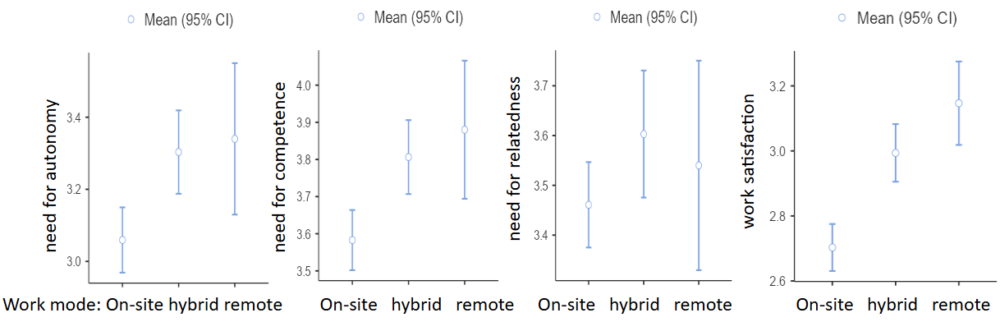
In the mediation analysis examining the role of basic psychological needs satisfaction in the relationship between work arrangement and work satisfaction, only autonomy emerged as a significant mediator, both in comparison between on-site and remote workers and between on-site and hybrid workers. Satisfaction of competence and relatedness needs did not play a mediating role in this relationship.
Regardless of work arrangement, core self-evaluations were directly associated with work satisfaction. However, a mediating role was observed only for autonomy need satisfaction, and only among on-site and hybrid workers. Among remote workers, satisfaction of autonomy, competence, or relatedness needs did not mediate the relationship between core self-evaluations and work satisfaction.
SUMMARY | The results indicate that work arrangements differentiate the level of satisfaction of selected basic psychological needs and work satisfaction. It was observed that more flexible forms of work (remote and hybrid) may promote a greater sense of autonomy, competence, and work satisfaction. Interestingly, no differences were found between groups in the satisfaction of the need for relatedness, suggesting that the need to belong to a work community and having professional relationships were met to a similar extent across all work arrangements in the studied sample.
The analyses also pointed to the important role of autonomy in the relationship between work arrangement and core self-evaluations and work satisfaction. Satisfaction with the need for autonomy was clearly lower among on-site workers compared to employees working remotely or in a hybrid model. Despite certain limitations of the study, such as the sample sizes across work arrangement groups and the cross-sectional nature of the analysis, the findings suggest that a sense of having an influence on our work and freedom of choosing the course of action may play a particularly important role in shaping work satisfaction. This is an important result, as work satisfaction is not merely a momentary sense of contentment with performed tasks but also an important indicator of work environment quality, linked both to occupational effectiveness and employees’ psychological well-being.

Views: 23