


 News
News
~ 1 470 words | ~ 8 823 characters | Reading time: 6 minutes
The price of agency: Gender stereotypes and support for online feminist campaigns
Online feminist campaigns may be oriented towards similar forms of social change, while at the same time differing in the way they are perceived and interpreted by audiences. Does public support for such movements depend on the extent to which they are perceived as consistent with traditional, stereotypical views of women? In a series of three studies, Dr. Marta Witkowska (PSPS regular member; SWPS University) and an international team of researchers examined the relationship between perceived consistency with stereotypes and the popularity and level of support for feminist campaigns.
Dr. Marta Witkowska is the recipient of the PSPS Early Career Researcher Award (2026 edition).

INTRODUCTION | The #MeToo campaign gained international attention in 2017, when social media users began sharing their personal experiences of sexual harassment and violence, marking their posts with the campaign’s hashtag. Through thousands of individual stories, the campaign transformed private experiences into a collective narrative highlighting the scale of this social problem.
The success of #MeToo may have been partly due to the fact that, although the movement encouraged women to fight for social change, it could simultaneously be perceived as, to some extent, consistent with what is stereotypically expected of women. The campaign emphasised communion, reflected in mutual support and the sharing of experiences of violence and powerlessness associated with experiences of victimization. Both of these elements are strongly linked to stereotypical perceptions of women.
Not all feminist campaigns emphasise these stereotypical attributes to the same extent. A different example is #SexStrike, a campaign that encouraged women to engage in temporary sexual abstinence as a form of protest against restrictions on reproductive rights. Whereas #MeToo focused on building a sense of community and mutual support, #SexStrike was based on individual acts of opposition and active resistance. As a result, this campaign may have been perceived to a greater extent as violating traditional gender norms, as it promoted assertively challenging the existing social order and taking control over one’s own situation, that is, agency, a trait stereotypically attributed more often to men than to women.
Dr. Marta Witkowska and an international team of researchers sought to examine whether the perceived consistency of feminist campaign messages with gender stereotypes is related to the level of support they receive. To address this question, they conducted a series of three studies investigating perceptions of the #MeToo and #SexStrike movements and their relationship with declared support for these campaigns.
HYPOTHESES | It was predicted that content published as part of the #MeToo campaign would refer more strongly to communion and less strongly to agency than content associated with the #SexStrike campaign and would therefore be more consistent with the traditional stereotype of femininity.
It was also expected that a campaign modelled after #MeToo would be more frequently associated with characteristics congruent with the traditional feminine stereotype than a campaign modelled after #SexStrike. Furthermore, it was predicted that campaigns perceived as more consistent with the stereotypical image of femininity would receive greater support than campaigns perceived as inconsistent with this stereotype.
STUDY 1 | The aim of Study 1 was to analyze the content of English-language posts published on Twitter (now X) under the hashtags #MeToo and #SexStrike (N = 482 000 posts).
RESULTS | Consistent with the hypothesis, posts related to the #SexStrike campaign contained more expressions referring to agency than posts related to #MeToo. In contrast, posts published as part of #MeToo referred more frequently to communion than content associated with #SexStrike. Furthermore, the analysis of social media activity showed that #MeToo was considerably more popular than #SexStrike. During the period covered by the analysis, the #MeToo movement generated more than one hundred times as many posts as the #SexStrike campaign, indicating substantial differences in the social reach of the two initiatives.
STUDY 2 | In Study 2, conducted among residents of the United Kingdom (N = 195), participants evaluated gender-related campaign characteristics and their declared support for three campaigns modelled after #SexStrike, #InternationalWomensDay, and #MeToo. To reduce the influence of prior familiarity with these campaigns, each was assigned a new, fictitious hashtag (#women4women, #yesTOwomen, or #ForeverWomen).
Campaign characteristics – participants rated the extent to which they associated each campaign with 35 different concepts, grouped into six broader categories:
- Victimhood, e.g., being a group that is discriminated, suffering
- Community orientation, e.g., common ground with other women, solidarity
- Rebelliousness, e.g., complaining, revolution
- Action for change, e.g., readiness to engage, action
- Experiencing negative emotions, e.g., sadness, helplessness
- Positive identity, e.g., joy, pride
Campaign support – was measured using 2 questions: To what extent would you support this movement? To what extent would you be willing to retweet content posted within this movement?
RESULTS | As expected, the #MeToo campaign was more frequently associated with victimhood, community orientation, negative emotions, and positive identity than the #SexStrike and #InternationalWomensDay campaigns. In turn, the #SexStrike campaign was associated with rebelliousness to a greater extent than the other two campaigns. Participants associated #MeToo and #SexStrike equally strongly with action for change. However, both campaigns were associated with action for change more strongly than #InternationalWomensDay. The analyses also revealed significant differences in the level of declared support for the campaigns. The #SexStrike campaign received significantly less support than #MeToo and #InternationalWomensDay, whereas support for the latter two campaigns did not differ significantly.
The research team then examined whether campaign characteristics mediated the relationship between campaign type and the level of support it received (see Figure 1). The mediation analysis showed that lower support for the #SexStrike campaign (compared to #MeToo) was associated with the campaign being more strongly linked to rebelliousness and less strongly linked to victimhood, community orientation, and positive identity.
Figure 1. Mediation analysis of the relationship between campaign type and the level of support it received through six campaign characteristics.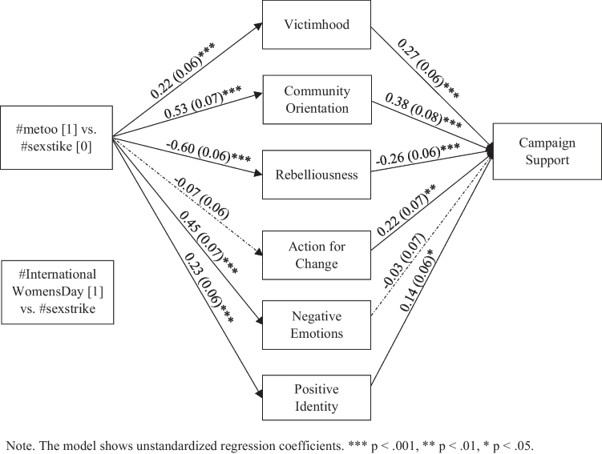
STUDY 3 | Study 3 was conducted using an experimental design among residents of the United Kingdom (N = 446). Each participant was randomly presented with one of four descriptions of a fictitious feminist campaign and was then asked to evaluate their perceptions of the campaign and their level of support for it. The campaigns differed in their consistency with the traditional feminine stereotype (communion vs. agency) and their normativity (legal vs. illegal forms of action). Campaign support was assessed in the same way as in Study 2. Campaign characteristics, however, were measured using the following instruments:
Communal values of the campaign – assessed using 12 communal values adapted from the measure developed by Trapnell and Paulhus (2012), e.g.,. loyalty
Agentic values of the campaign – oassessed using 12 agentic values adapted from the measure developed by Trapnell and Paulhus (2012), e.g., ambition
Communal traits of the campaign – measured using 6 communal traits from the scale developed by Wojciszke and Szlendak (2010), e.g., compassion
Agentic traits of the campaign – measured using 6 agentic traits from the scale developed by Wojciszke and Szlendak (2010), e.g., efficiency
RESULTS | The results confirmed the predictions that campaigns presented as consistent with the traditional feminine stereotype were more strongly associated with communal values and communal traits than campaigns presented as inconsistent with this stereotype. At the same time, campaigns inconsistent with the feminine stereotype were more strongly associated with agentic values. No differences were observed, however, in the agentic traits attributed to the campaigns. In addition, campaigns described as operating within legal boundaries were more frequently associated with communal values and communal traits than campaigns encouraging illegal activities.
A comparison of the experimental conditions showed that participants were more likely to support campaigns presented as consistent with the traditional feminine stereotype than campaigns presented as inconsistent with this stereotype. Additionally, campaigns described as operating within legal boundaries received greater support than campaigns encouraging illegal activities. Importantly, these two effects were independent of one another, suggesting that consistency with gender stereotypes influenced campaign support independently of the normativity of the actions promoted by the campaign.
SUMMARY | The findings of the three studies suggest that public support for feminist campaigns may depend not only on the goals they promote but also on the extent to which the way these goals are presented aligns with stereotypical perceptions of femininity. Campaigns emphasizing communion, solidarity, and shared experiences appear to receive more favorable responses than actions highlighting rebellion and open opposition to the existing social order.
At the same time, the findings point to a certain paradox. Feminist movements, whose aim is often to challenge traditional gender norms and stereotypes, may receive greater acceptance when they themselves conform to a stereotypical image of femininity. The authors note, however, that while strategies based on communion may generate greater public support in the short term, more agentic and stereotype-challenging actions may be important for achieving long-term social change. It should also be noted that the studies focused on declared support for online campaigns rather than participants’ actual behavior. Despite these limitations, the findings demonstrate that gender stereotypes may influence not only evaluations of individual people but also the way entire social movements advocating for gender equality are perceived.

Photo by deagreez from Adobe Stock
Views: 8