


 News
News
~ 960 words | ~ 6 229 characters | Reading time: 4 minutes
Gains, losses, and risk: how experts make decisions for themselves and others
Every day, we make decisions not only on our own behalf but also on behalf of other people. Do experts who regularly make decisions affecting others as part of their work evaluate risk differently when deciding for themselves than when deciding for someone else? To answer this question, Dr. Lewend Mayiwar (Oslo Metropolitan University) conducted four experimental studies involving professionals, examining their decisions in situations involving gains, losses, and risk.
Dr. Lewend Mayiwar received the Solomon Asch Award for the article on which this summary is based, published in Social Psychological Bulletin.

INTRODUCTION | Making decisions on behalf of others is an integral part of many professional roles. Financial advisors recommend investment strategies to clients, managers make decisions concerning their teams, and organizational leaders choose solutions that affect the functioning of their employees. Despite the prevalence of such situations, it remains unclear whether people make decisions in the same way when the consequences affect themselves as when the consequences affect others.
Previous research on differences between decisions made for oneself and for others has produced mixed findings. Some studies suggest that making decisions for others is associated with a greater willingness to take risks, whereas others point to more cautious choices or no significant differences. These inconsistencies may result from the type of decision being made, the nature of the relationship with the decision recipient, and the specific context in which the decision is made. According to Prospect Theory, people exhibit loss aversion, that is, a tendency to respond more strongly to potential losses than to equivalent gains. As a result, safe options are more often chosen when decisions are framed in terms of potential gains, whereas people are more likely to choose risky options when the same outcomes are presented in terms of potential losses.
In four experimental studies conducted among members of different professional groups, Lewend Mayiwar examined whether the decision recipient influences risk preferences while simultaneously taking into account the effect of framing decision outcomes as gains or losses. In the experiments, cognitive processing mechanisms were also assessed, specifically whether making decisions on behalf of others (vs. oneself) are driven less by intuition and more by analytical processing.
HYPOTHESES | The author predicted that individuals making decisions for others would exhibit different risk preferences than those making decisions for themselves, and that this would be moderated by whether a situation was framed in terms of gains or losses. It was also hypothesized that participants who made decisions for others, compared to those who made decisions for themselves, would report less reliance on intuition (i.e., relying on one’s “gut” and feelings) and more analytical processing.
METHOD | Four preregistered experiments were conducted with a total of 1,337 participants in Norway. In each experiment, participants chose between a safe option and a risky option, and reported their reliance on intuition and analysis, as well as how emotionally intense they experienced the decision scenarios. One experimental group made decisions for themselves, whereas the other made decisions on behalf of a hypothetical other person. The decision scenarios were tailored to the professional backgrounds of the participants:
Experiment 1: Financial advisors from a large trade union organization solved financial decision-making dilemmas (N = 271).
Your new client wishes to save NOK 500,000 over a period of 10 years to secure additional funds for retirement. You will now be presented with two different sets of options. Based on the information provided, you will be asked to recommend one fund from each set.
Fund T: If Fund T is chosen, the expected gain at the time of withdrawal will be NOK 240,000.
Fund M: If Fund M is chosen, there is a 1/3 probability of achieving a gain of NOK 720,000, but also a 2/3 probability of achieving no gain at all.
After indicating their preference for Fund T or Fund M (a gain-related decision), participants were presented with a second set of options concerning losses
Fund K: If Fund K is chosen, the maximum loss at the time of withdrawal will be NOK 250,000.
Fund S: If Fund S is chosen, while offering the same expected annual return as Fund K, there is a 2/3 probability of incurring a loss of NOK 375,000, but also a 1/3 probability of incurring no loss at all.
Experiment 2: Local government managers were presented with organizational and managerial decision-making scenarios (N = 237).
Experiment 3: Employees and managers at a large hospital made decisions related to healthcare management (N = 239).
Experiment 4: A general sample of employees and leaders from various sectors made decisions concerning salary levels (N = 590).
RESULTS | Contrary to the hypotheses, there was no significant effect of making decisions for oneself versus for others on risk preferences, and no interaction with the way the problem was framed (gain vs. loss) in any of the experiments. There was also very weak to no evidence for effects on intuition, analytical processing, and emotional arousal.
However, consistent with Prospect Theory predictions, participants across all experiments were more willing to take risks in the loss condition than in the gain condition (see Figure 1).
Figure 1. Risk preferences as a function of decision recipient (self vs. other) and decision frame (gain vs. loss) across the four experiments.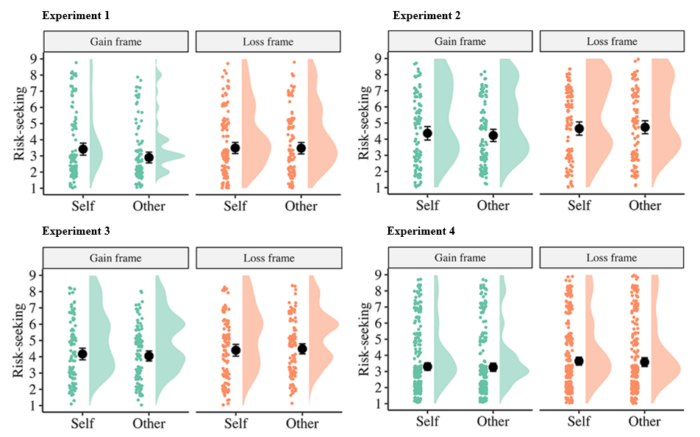
SUMMARY | The findings clearly indicated no significant differences in willingness to take risks depending on whether experts were making decisions for themselves or for another person, and almost no differences in cognitive processing and emotional arousal.
Instead, the way the decision problem was framed proved to be far more important. Across all four experiments, participants were more willing to take risks when situations were presented in terms of potential losses than when they were described in terms of potential gains. These findings suggest that, in professional contexts, differences between decisions made for oneself and for others are minimal, whereas the influence of gains and losses on risk perception remains remarkably stable.

Photo by ellisia from Adobe Stock
Views: 10