


 News
News
~ 1 305 words | ~ 8 755 characters | Reading time: 5 minutes
Thinking about the future or caring about others? What drives pro-environmental actions?
Climate change is one of the greatest challenges facing the modern world. However, the effects of actions aimed at protecting the environment often become visible only many years later. What makes some people more likely than others to engage in pro-environmental actions? Is it driven by concern for the common good, moral values, or perhaps the way people perceive time and think about the future? These questions were explored by Dr Iwona Nowakowska (PSPS regular member; The Maria Grzegorzewska University) and Prof. Michael Rönnlund (Umeå University), who analysed data from a Polish-Swedish sample.
The study on which the article is based was supported by funding from the PSPS Research Grant programme (2022 edition).
 Iwona Nowakowska
  Michael Rönnlund
INTRODUCTION | Pro-environmental actions often require us to give up immediate benefits in favour of outcomes that may only become visible in the future. Some of these actions, such as saving electricity or reducing food waste, bring not only environmental benefits but also tangible savings for the household budget. In the case of other behaviours – such as buying fewer clothes, travelling by plane less frequently, or reducing meat consumption—personal benefits are less obvious, and psychological factors may play a greater role. It was precisely these individual characteristics, such as social value orientation, moral foundations, and time perspective, that Dr. Iwona Nowakowska and Prof. Michael Rönnlund examined in relation to pro-environmental behaviours.
Social value orientation describes the extent to which people, when making decisions, take the well-being of others into account rather than focusing solely on their own benefits. Individuals who are more oriented towards cooperation and reciprocity are more likely to consider the consequences of their actions for others, even when this requires giving up some personal gains. This way of thinking may also encourage pro-environmental actions, as many of them serve the common good and produce benefits that extend beyond the interests of a single individual. A similar role may be played by moral foundations – basic intuitions and values that influence how we judge behaviours as right or wrong. Individualizing foundations focus on care for others and fairness, whereas binding foundations refer to loyalty to one’s group, respect for authority, and beliefs related to purity and sanctity. While social value orientation primarily reflects whether we consider the well-being of others, moral foundations help explain why we perceive certain actions as morally right or wrong.
The researchers also examined time perspective, referring to the way people perceive the past, present, and future. Of particular importance for pro-environmental behaviours may be future orientation—the tendency to plan and consider the long-term consequences of one’s decisions. People who are more focused on the future may be more willing to engage in actions whose effects are not immediate but bring benefits over time. At the same time, the authors assumed that the role of time perspective may depend on the broader social context and the values held by individuals. Therefore, they compared residents of Poland and Sweden – countries that differ both in the history of environmental policies and in the level of social engagement with ecological issues. This allowed them to examine whether the relationships between thinking about the future, social values, and pro-environmental behaviours take a similar form across different cultural contexts.
HYPOTHESES | The researchers predicted that social value orientation would be positively associated with pro-environmental behaviours and intentions to engage in such behaviours. They also expected that individualizing moral foundations (related to care for others and fairness) would promote pro-environmental behaviours, whereas binding moral foundations (related to group loyalty, authority, and sanctity) would be negatively associated with them.
The authors also expected differences between countries – in Poland, future orientation would be evident mainly among individuals with a high social value orientation, whereas in Sweden this relationship was expected to occur regardless of the level of social value orientation. Additionally, they explored whether time perspective was associated with pro-environmental behaviours and intentions to engage in such behaviours.
METHOD | The study was conducted using the research platform Prolific. A total of 301 participants took part in the study: 150 from Poland (aged 18–57 years) and 151 from Sweden (aged 18–63 years). Participants answered demographic questions and completed measures assessing the following variables:
Social value orientation – was measured using the decomposed game (Murphy et al., 2011),
in which participants made six decisions about how to divide financial resources between themselves and an unknown other person. This measure allowed the researchers to determine the extent to which participants were guided by self-interest versus concern for others.Moral foundations – were assessed using 30 statements adapted from Graham et al. (2011).
The questionnaire measured two types of moral foundations: individualizing foundations (harm/care and fairness/reciprocity), e.g., When deciding whether someone’s behaviour is good or bad, how important is it whether or not someone suffered emotionally?; and binding foundations (ingroup/loyalty, authority/respect, and purity/sanctity), e.g., When deciding whether someone’s behaviour is good or bad, how important is it whether or not someone showed a lack of respect for authority?Time perspective – was measured using three subscales of the Time Perspective Inventory (Zimbardo & Boyd, 1999): future orientation (13 items), e.g., When I want to achieve something,
I set goals and consider specific means for reaching those goals; hedonistic present orientation (15 items), e.g., I do things impulsively; and fatalistic present orientation (9 items), e.g., Since whatever will be will be, it doesn’t really matter what I do.Pro-environmental behaviors – participants indicated how often they had engaged in 7 listed pro-environmental behaviours during the previous six months, e.g., chosen local products over imported ones.
Pro-environmental behaviors’ intentions – participants also indicated the extent to which they were willing to engage in the same seven behaviours during the following six months, e.g., chosen local products over imported ones.
RESULTS | The analysis showed that the relationship between social value orientation and pro-environmental behaviours depended on future orientation. Future orientation was associated with more frequent engagement in pro-environmental behaviours during the previous 6 months only among individuals with a low level of social value orientation, that is, those who were more focused on their own interests. However, this relationship was not observed among individuals with average or high levels of social value orientation (see Figure 1).
Figure 1. Interaction of future time perspective and social value orientation in predicting pro-environmental behaviors.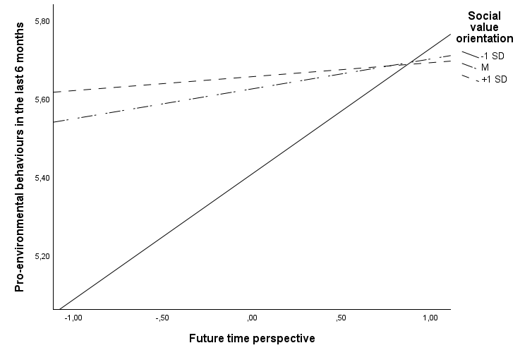
The study also showed that older participants and those with higher levels of individualizing moral foundations reported more pro-environmental behaviours and stronger intentions to engage in such behaviours. This means that people for whom values related to care for others and fairness are particularly important were more likely to take action for the environment and expressed greater willingness to do so in the future. In contrast, binding moral foundations and present-oriented perspectives were not significantly associated with pro-environmental behaviours.
Contrary to the authors’ expectations, no differences between Poland and Sweden were found. The relationships among future orientation, social value orientation, and pro-environmental behaviours were similar in both countries.
SUMMARY | The study shows that people who are guided by the common good are likely to engage in pro-environmental behaviours regardless of how strongly they focus on the future. In their case, the motivation to protect the environment appears to be already relatively strong. In contrast, among individuals who are more focused on their own benefits, thinking about the long-term consequences of their actions may provide additional motivation to make more environmentally friendly choices.
The findings also indicate that older people more often report engaging in pro-environmental behaviours, suggesting that their experiences and habits can serve as a valuable source of good practices for younger generations. Based on these results, the authors suggest that effective public campaigns should be tailored to different motivations of their audiences rather than relying on a single, universal message.
✍️ ORIGINAL TEXT Nowakowska, I., & Rönnlund, M. (2023). Future of nature, our future. A preregistered report on future time perspective, social value orientation, and pro-environmental outcomes based on data from Poland and Sweden. Frontiers in Psychology, 14, article 1217139.

Photo by sutlafk from Adobe Stock
Views: 33