


 News
News
~ 1 209 words | ~ 8 222 characters | Reading time: 5.5 minutes
From gray to color: Where do we want to live and what does it say about our cultural capital?
After decades of gray, communist-era blocks, Polish cities entered the age of pastelosis – an aesthetic characterized by intensely colorful, often multicolor façades. For some, this was a long-awaited attempt to enliven public space, for others, it signaled a decline in aesthetic taste in Polish cities. Do we prefer living among gray buildings or in pastelosis blocks, or perhaps something in between? Are these preferences related to our cultural capital? These questions were addressed in experimental studies conducted by PSPS junior member Mateusz Strzałkowski and PSPS regular member Prof. Maria Lewicka from Nicolaus Copernicus University.
 Mateusz Strzałkowski
  Maria Lewicka


INTRODUCTION | Not long ago, Polish housing estates were almost entirely gray. Concrete apartment blocks from the communist era shaped an urban landscape that was uniform and austere. After the political transformation of 1989, many of these buildings gained new, colorful façades. However, the phenomenon of pastelosis has numerous critics who argue that such façades represent kitsch and bad taste. This criticism led to the development of design projects meant to counteract pastelosis, known as antipastelosis. This approach limits the number of colors and patterns on façades in favor of muted tones, usually white, in line with modernist principles of restraint and reduction of ornamentation.
In two experimental studies, Mateusz Strzałkowski and Maria Lewicka examined which façades we like most, which buildings we would prefer to live in, and whether preferences for pastel colors in public space reflect universal human aesthetic tendencies or “lack of taste”, meaning low cultural capital. The authors also compared evaluations of experts in architecture and urban planning with those of people without such education.
HYPOTHESES | The researchers predicted that gray façades would be less accepted than colorful ones. We also expected that antipastelosis would be preferred to pastelosis. Experts were expected to evaluate pastel façades more critically and anti-pastel ones more favorably than laypersons. Additionally, individuals with lower cultural capital were expected to show higher acceptance of pastelosis.
EXPERIMENT 1 | The study included two groups of participants: experts (architects, landscape architects, urban planners; N = 252) and laypersons (N = 320). Participants were asked to imagine living in the building shown in the photograph or nearby—a block with a traditional gray façade—and to rate the attractiveness of the building and their willingness to live in it.
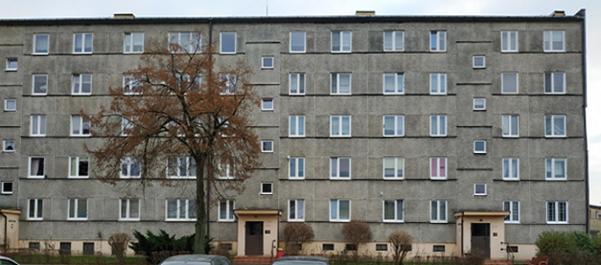
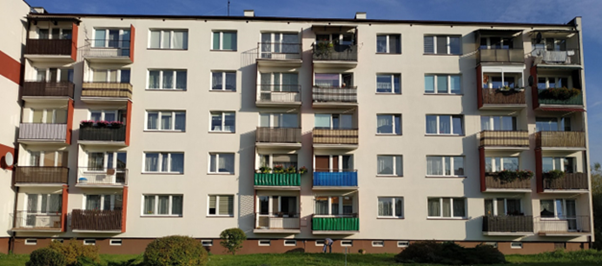
In the next step, participants were informed that the façade would change, and their task was to evaluate this change. All participants viewed three versions of the changed façade presented in random order (1) pastelosis, (2) a medium level of pastelosis and (3) antipastelosis.
(1) Pastelosis
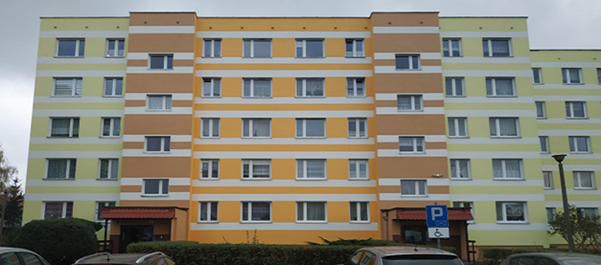
(2) Medium pastelosis
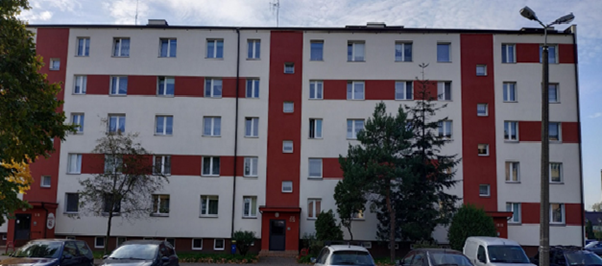
(3) Antipastelosis
After each façade change, participants were asked to indicate their willingness to live in the building, their evaluation of the façade’s attractiveness and acceptance of the modification. In the second part of the study, they completed a cultural capital questionnaire.
Liking of the façade – measured with the question How much do you like this elevation?
Willingness to live in the building – assessed with the question How much would you like to live in a building with such a façade?
Acceptance of façade change – acceptance of the change from gray to one of three colored versions was measured using the 10-item Acceptance of Place Change Scale developed by Strzałkowski (2019), np. This place has lost its character.
Cultural capital – was assessed across several domains. Materialized cultural capital was measured by the number of cultural goods owned, such as books, paintings, CDs, and vinyl records. Institutionalized cultural capital was measured through the educational level of participants and their parents. Embodied cultural capital was assessed using a cultural interests questionnaire developed by Lewicka (2013).
RESULTS | Façade attractiveness and willingness to live in the building. As predicted, the gray façade was liked the least, followed by pastelosis, then the medium level of pastelosis. The antipastelosis façade was liked the most. A similar pattern appeared for willingness to live in the building: participants were the least willing to live in a gray block, followed by pastelosis. No differences were found between the medium level of pastelosis and antipastelosis in willingness to live. Experts did not differ from laypersons in their dislike of the gray façade. However, they rated all colorful variants more negatively and were less willing to live in these buildings.
Acceptance of façade change. Also, in line with predictions, changing a gray façade to pastelosis was accepted less than changing it to antipastelosis or to a medium level of pastelosis. Moreover, experts were overall less willing to accept any façade changes compared to laypersons.
Cultural capital. Low cultural capital, i.e., popular tastes, was positively associated with acceptance of colorful façades. High cultural capital played a subtler and less consistent role, depending on participants’ cultural profiles.
EXPERIMENT 2 | The study included 171 experts and 336 laypersons.
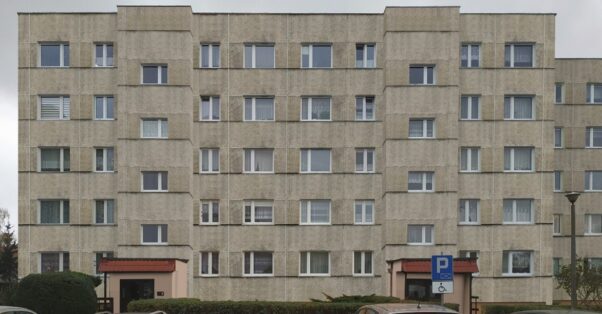
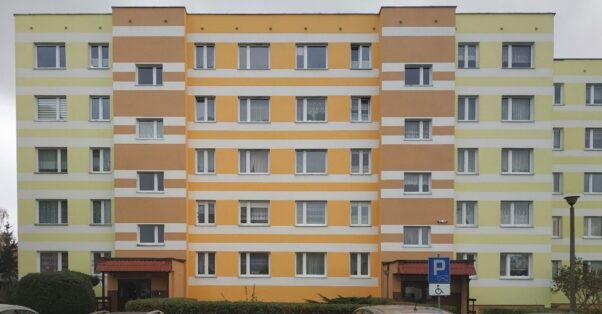
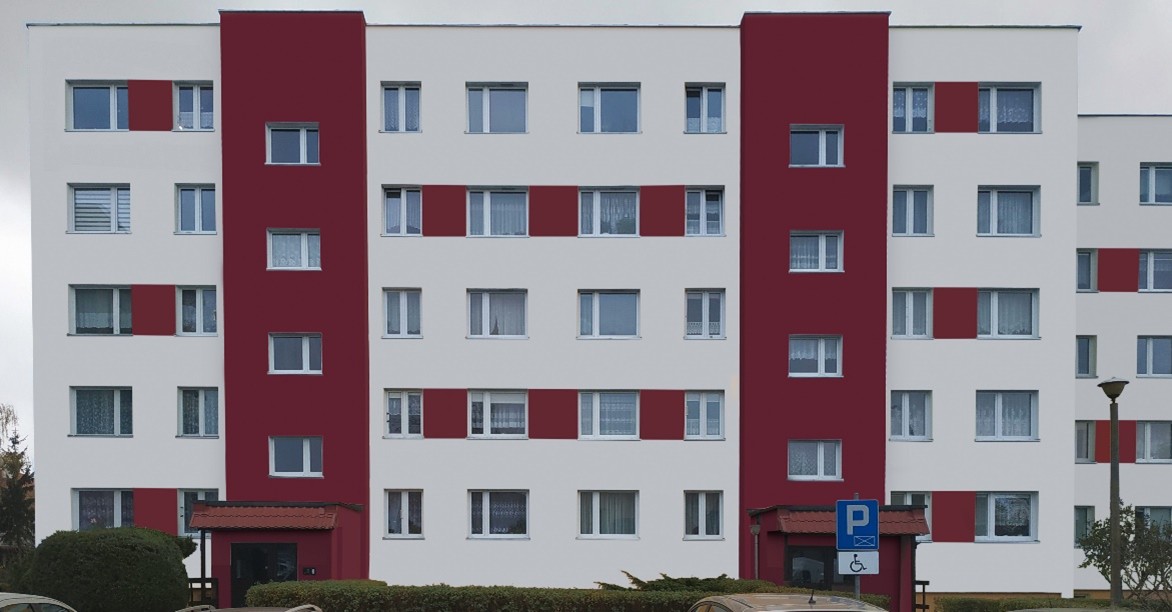
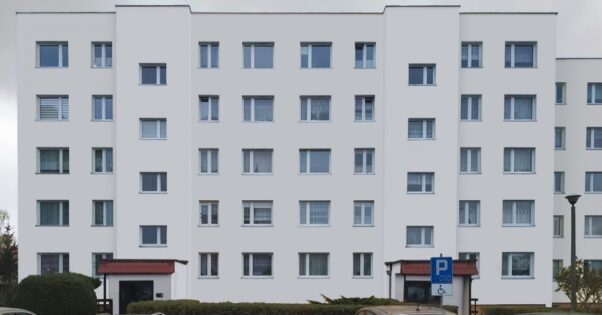
To eliminate potential differences resulting from the characteristics of the photographs (i.e., the presence of vegetation, lighting, or variations in color saturation), Study 2 used images of the same building with digitally applied different versions of the façade. The same procedure and measures as in Study 1 were employed.
(1) Gray façade
(2) Pastelosis
(3) Medium pastelosis
(4) Antipastelosis
RESULTS | Façade attractiveness and willingness to live in the building. Replicating the findings of Study 1, the gray façade was evaluated as the least attractive and the least preferred for living. Replicating the findings of Study 1, the gray façade was evaluated as the least attractive and the least preferred for living. Participants were also less willing to live in and liked buildings with pastel-colored façades less.
Compared to laypersons, experts rated the gray, pastel, and medium-pastel façades as less attractive. Both groups, however, did not differ in their evaluation of antipastelosis façades, which were liked to a similar degree. Moreover, experts and laypersons did not differ in their stated willingness to live in buildings with gray or antipastelosis façades. Differences between the groups were significant, however, for pastel and medium-pastel façades: experts were substantially less willing to live in buildings with these façades than laypersons.
Acceptance of façade change. As in Study 1, changing a gray façade to pastelosis received the lowest level of acceptance. Changes to antipastelosis and to medium pastelosis were evaluated more positively. Experts and laypersons did not differ in acceptance of change to antipastelosis, but experts were less accepting of pastelosis and medium pastelosis.
Cultural capital. Popular tastes positively predicted both liking and willingness to live in buildings with pastelosis, medium pastelosis, and antipastelosis. They also predicted greater acceptance of changing gray façades to pastelosis and medium pastelosis variants. Overall, aesthetic preferences showed more consistent relationships with low cultural capital than with high cultural capital.
SUMMARY | Two experimental studies indicated that people prefer colorful façades over traditional gray ones. However, this does not imply unconditional approval of all forms of colorful façades. The most positively evaluated solutions were those described as antipastelosis. Intense pastelosis was viewed less favorably, although still better than plain gray. Experts were more critical of most colorful façades than laypersons, though both groups evaluated the most muted variants similarly. At the same time, aesthetic preferences were linked to cultural capital – individuals with more popular tastes tended to accept pastel façades more readily and were more open to living in such buildings
The authors suggest that the most promising approach to façade color design lies in a compromise between residents’ preferences and professional architectural standards – that is, using color in a moderate and deliberate way.
Views: 21