


 News
~ 1 204 words | ~ 8 368 characters | Reading time: 5 minutes
When does gaming become a problem: The role of gratification and compensation motivations
Video games can be a source of entertainment, but they may also serve as a way of regulating emotions and escaping everyday problems. Can the motivations that drive us to play video games influence later difficulties in reducing or stopping gaming? This question was addressed in a study conducted by Dr. hab. Paweł Strojny (PSPS regular member; Jagiellonian University) and colleagues.

INTRODUCTION | An analysis conducted by Gisbert-Pérez and colleagues, published in 2026, indicates that approximately 6% of the young adults screened may meet the criteria for gaming disorder. Although this percentage may seem relatively small, it translates into around 135 million individuals aged 18-35 worldwide. This is particularly important because young adulthood is a period of major life transitions associated with shaping one’s educational, professional, and personal future.
Gaming disorder does not simply refer to playing video games frequently. It is characterized by a loss of control over the amount of time spent gaming and the way gaming is engaged in, the gradual prioritization of gaming over other activities, and continued gaming despite negative consequences. Individuals experiencing this problem may develop withdrawal symptoms when unable to play, make unsuccessful attempts to reduce or stop gaming, and consequently face risks to or loss of important relationships, as well as educational and occupational opportunities.
To better understand why some individuals develop problematic gaming patterns, it is worth examining the motivations that drive them to play video games. Gaming motivations can be divided into two broad categories. The first includes gaming aimed at experiencing positive psychological states, referred to as gratification motivations. These include, among others, seeking enjoyment and entertainment, pursuing personal interests, and building social relationships. The second category, known as compensation motivations, involves using video games as a way of coping with stress, negative emotions, or everyday problems. In other words, gaming serves the function of regulating or avoiding unpleasant emotional states.
Previous research has relied primarily on cross-sectional studies showing that individuals with more severe symptoms of gaming disorder tend to report both gratification and compensation motivations more frequently. However, such studies can only demonstrate that variables co-occur and cannot determine the direction of the relationship between them. The study conducted by Dr. hab. Paweł Strojny and colleagues sought to address this gap by examining whether specific gaming motivations act as risk factors that precede the development of gaming disorder, or whether they are instead consequences of the disorder or relatively stable characteristics of individuals experiencing elevated symptom levels.
HYPOTHESES | The researchers expected positive associations between both gratification and compensation motivations and the severity of gaming disorder symptoms.
In the longitudinal analyses, they predicted that higher baseline levels of gratification motivations would be associated with greater gaming disorder symptom severity at subsequent measurement waves. In turn, higher initial gaming disorder symptom severity was expected to lead to a later increase in compensation motivations.
METHOD | The study consisted of three waves of data collection conducted at three-month intervals. A total of 438 participants aged 18 to 27 years took part in all three measurement waves. At each wave, participants completed an online questionnaire assessing the following variables:
Gaming Disorder symptoms – symptom severity was assessed using the 9-item Polish validation of the Internet Gaming Disorder Scale–Short Form (Schivinski et al., 2018), e.g., Have you jeopardized or lost an important relationship, job or an educational or career opportunity because of your gaming activity?
Gratification gaming motivations – were assessed across two domains: fantasy (4 items) and identity (5 items), using the Polish version of the Gaming Motivation Inventory (Strojny et al., 2026), e.g., Why do you play video games? I play video games: because I can be in another world (fantasy); because it is an integral part of my life (identity).
Compensation gaming motivations – were assessed across tthree domains: coping (3 items), escape (4 items), and introjected regulation (3 items), using the Polish version of the Gaming Motivation Inventory (Strojny et al., 2026), e.g., Why do you play video games? I play video games: because it helps me get my anger out (coping); to forget about unpleasant things or offences (escape); because I feel that I must play regularly (introjected regulation).
RESULTS | Consistent with the hypotheses, both gratification and compensation motivations were associated with higher gaming disorder symptom severity across all three measurement waves.
Next, longitudinal analyses were conducted to examine both overall associations observed across the entire sample (CLPM) and changes occurring within the same individuals over time (RI-CLPM).
Contrary to expectations, gratification motivations did not predict subsequent gaming disorder symptom severity. This indicates that although individuals with higher symptom severity more frequently reported motivations related to Fantasy and Identity, these motivations did not act as antecedents of increasing problematic gaming over time.
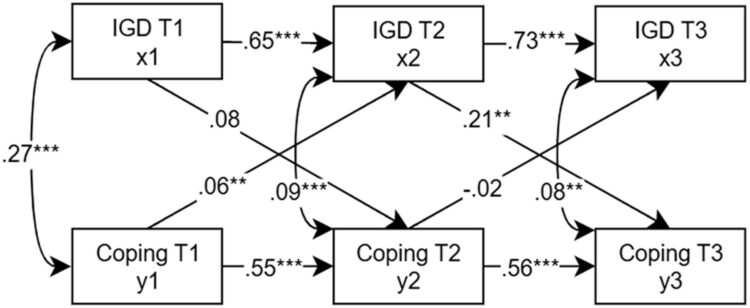
More complex patterns emerged for compensation motivations. In the case of Coping, a delayed bidirectional relationship was observed (see Figure 1). Stronger motivations to use video games as a way of coping with difficulties predicted higher gaming disorder symptom severity at a later time point. At the same time, higher symptom severity was associated with a subsequent increase in coping-related gaming motivations.
Figure 1. Associations between gaming disorder symptom severity (IGD) and Coping across three measurement waves.
In the case of Escape, the findings also pointed to a delayed relationship between this motivation and gaming disorder symptom severity. Analyses focusing on within-person changes showed that higher levels of Escape predicted greater symptom severity at a later time point, whereas higher symptom severity at the second measurement wave was associated with higher levels of Escape at the subsequent wave. These findings suggest a mutually reinforcing relationship between escape-motivated gaming and problematic gaming over time.
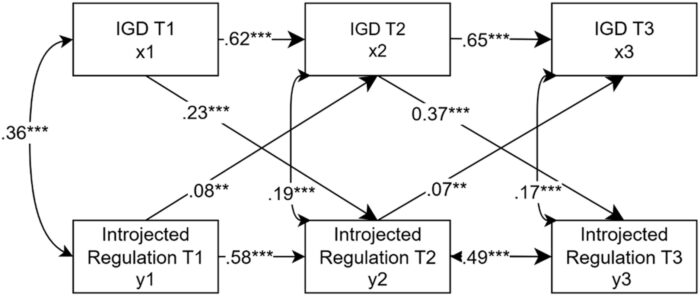
Compensation motivations related to Introjected Regulation predicted higher gaming disorder symptom severity, while higher symptom severity was in turn associated with a subsequent increase in Introjected Regulation (see Figure 2). However, these relationships emerged only in analyses conducted at the level of the entire sample. Once changes occurring within the same individuals over time were taken into account, these effects were no longer statistically significant. This suggests that the observed associations reflected relatively stable differences rather than actual processes unfolding over time.
Figure 2. Associations between gaming disorder symptom severity (IGD) and Introjected Regulation across three measurement waves.
SUMMARY | The findings demonstrate that not all gaming motivations play the same role in the development of gaming disorder. Although both gratification and compensation motivations were associated with higher gaming disorder symptom severity, only some of these motivations predicted changes in symptom severity over time.
Contrary to initial expectations, gratification motivations related to Fantasy and Identity did not predict subsequent gaming disorder symptom severity. Thus, while these motivations may represent common entry points into gaming and create conditions for initial engagement, they may not be sufficient on their own to explain why gaming escalates into problematic use in some individuals.
In contrast, selected compensation motivations appeared to play a more important role. The findings indicate that using video games as a way of coping with difficulties and negative emotions may both precede increases in gaming disorder symptom severity and emerge as a consequence of those symptoms, potentially contributing to a self-reinforcing cycle. These results highlight the importance of emotion regulation processes in the development of problematic gaming and suggest that prevention and therapeutic interventions should support the development of more adaptive ways of coping with stress and everyday difficulties.

Photo by Monkey Business from Adobe Stock
Views: 3