


 News
~ 1 532 words | ~ 10 518 characters | Reading time: 6.5 minutes
Violence in the name of one’s group – between defence and dominance
Ideologically motivated violence can be portrayed both as a necessary means of defending one’s own group and as a way of subjugating others. Are these two forms of extremism underpinned by different personality traits and beliefs? In a study spanning 58 countries, Prof. Jonas Kunst (BI Norwegian Business School), Assoc. Prof. Tomasz Besta (PSPS Peer Tribunal member; University of Gdańsk), and their colleagues examined the psychological and social factors associated with defensive and offensive extremist intentions.


INTRODUCTION | From the political propaganda of totalitarian regimes to contemporary international conflicts, aggressors often rely on a two-pronged rhetoric. On the one hand, they portray their actions as an absolute necessity to defend against threats, oppression, or the annihilation of their own group, invoking defensive motives. On the other hand, driven by offensive motives, they seek to expand their influence, impose their own ideology, and gain dominance over others.
These motives are associated with two distinct forms of violent extremism, understood as beliefs, attitudes, and actions that support or justify the use of violence in pursuit of ideological, social, or political goals. Defensive extremism is based on the belief that violence is a justified response to a threat and serves to protect one’s own group from attack, oppression, or annihilation. Offensive extremism, in turn, involves support for violence aimed at expanding influence, imposing one’s own beliefs, or gaining dominance over other groups. In both cases, violence may be perceived as serving the interests of one’s own community. However, the goals it is intended to achieve differ, as do the underlying conceptions of intergroup relations. These differences may also be reflected in the traits and beliefs of those who support violence.
In the case of defensive extremism, traits related to the need to protect one’s own position and the special status of one’s group may be important. Narcissism, which is reflected, among other things, in a sense of uniqueness and a belief in one’s own exceptional worth, may make people more likely to perceive criticism or unfavourable treatment as a threat to their position. Machiavellianism, in turn, which is associated with treating others instrumentally and a tendency to manipulate them, may be linked to a willingness to exploit other people and use various means to pursue one’s own interests. Psychopathy may also play a role, with characteristic features including low levels of empathy, impulsivity, and limited sensitivity to the consequences of one’s actions. These traits may foster acceptance of violence as a way of responding to perceived threats. Defensive extremism may also be associated with political beliefs and the way people identify with a particular political camp, including a more liberal political orientation.
In the case of offensive extremism, beliefs about how relations between groups should be structured and which groups should hold positions of dominance may be more important. In this context, social dominance orientation is particularly relevant, as it reflects the acceptance of hierarchy and intergroup inequality. Right-wing authoritarianism may also play a similar role, as it is expressed through adherence to traditional norms, submission to authority, and support for harsh punishment of those who violate the established order. Religious fundamentalism, in turn, which is based on the belief in the absolute truth of one’s own religious beliefs, may serve to justify imposing them on others. Such attitudes and beliefs are often associated with a more conservative political orientation.
The context in which individuals’ beliefs and attitudes develop is also important. The level of democracy and socio-economic development in a society, as well as experiences of violence and conflict, may be associated with the prevalence of different forms of extremist intentions. Do defensive and offensive extremist intentions occur at similar levels across different societies? Or does their prevalence depend on both individual dispositions and broader socio-political conditions? Prof. Jonas Kunst and Assoc. Prof. Tomasz Besta, together with their research team, sought to answer these questions by analysing data collected in 58 countries.
HYPOTHESES | The authors assumed that defensive and offensive extremist intentions represent two distinct, though related, dimensions that can be distinguished regardless of cultural context. They also predicted that defensive extremism would be more prevalent than offensive extremism, partly because violence undertaken in defence of one’s own group may be perceived as more morally justified than aggression aimed at gaining dominance over others.
The authors predicted that a conservative political orientation, social dominance orientation, religious fundamentalism, and right-wing authoritarianism would be more strongly associated with offensive than with defensive intentions. In contrast, a liberal political orientation, as well as narcissism, Machiavellianism, and psychopathy, were expected to show stronger associations with defensive intentions.
The authors also assumed that the prevalence of extremist intentions would depend on the socio-political and economic context. They predicted that levels of terrorism would be associated primarily with offensive intentions, while conflict, societal violence, and economic inequality would be associated with both types of intentions. In contrast, higher levels of democracy and socio-economic development were expected to be associated with a lower prevalence of extremist intentions.
METHOD | The preregistered study was conducted in 58 countries and included a total of 18,128 participants. The analyses took into account both cross-cultural comparisons, using macro-social indicators (such as levels of political terrorism and the occurrence of internal conflicts), and the individual traits and beliefs of the participants. Participants completed scales measuring:
Offensive and defensive extremism – each dimension was measured using 6 items developed by the study authors; offensive extremism, e.g., I’m personally ready to physically hurt other people to increase the dominance of my group; defensive extremism, e.g., I’m personally ready to physically hurt other people to defend members of my group who are being attacked.
Right-wing authoritarianism – measured using 3 items developed by Heller et al. (2020), e.g., Troublemakers should clearly feel the effects of the fact that they are unwanted in society.
Social dominance orientation – measured using 4 items from a scale developed by Aichholzer and Lechner (2021), e.g., Superior societal groups should dominate inferior groups.
Religious fundamentalism – measured using 3 items from the World Values Survey (2022), e.g., Whenever science and religion conflict, religion is always right.
Dark triad – comprising narcissism (e.g., I tend to want others to admire me), Machiavellianism (e.g., I tend to lack remorse) and psychopathy (e.g., I have used flattery to get my way) each measured using 3 items developed by Jonason and Webster (2010).
Political orientation – measured as the strength of identification with a group of people who share similar political views, using 4 items adapted from Leach et al. (2008); a politically liberal identification, e.g., Being a supporter of inclusiveness and advancing the rights of disadvantaged groups is an important part of how I see myself; a politically conservative identification, e.g., Being a supporter of values such as tradition and social order is an important part of how I see myself.
RESULTS | In 56 of the 58 countries, defensive extremism was significantly more pronounced than offensive extremism, suggesting greater social acceptance of violence justified as a means of defending one’s own group. At the same time, offensive extremism showed stronger associations with objective indicators of socio-political dysfunction at the country level, whereas the corresponding associations for defensive extremism were weaker or not statistically significant.
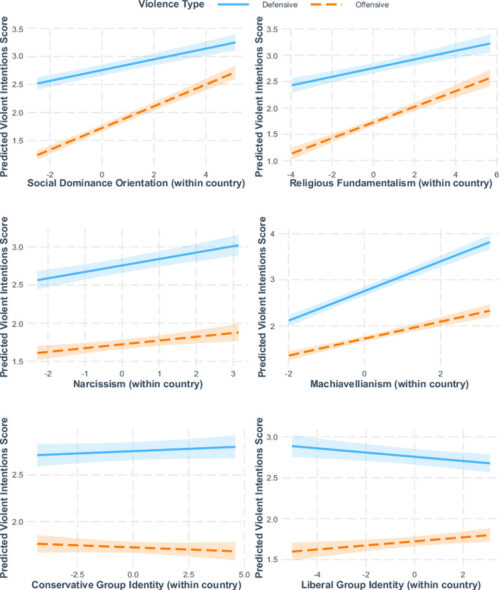
As predicted, social dominance orientation and religious fundamentalism were more strongly associated with offensive than with defensive violent extremist intentions (see Figure 1). Right-wing authoritarianism, in turn, was associated to a similar degree with both types of intentions. Identification with a conservative political group showed no significant associations with either type. Identification with a liberal political group was negatively associated with defensive intentions and positively associated with offensive intention, however, these associations were no longer significant after controlling for the other variables.
Also in line with the hypotheses, Machiavellianism and narcissism showed stronger associations with defensive than with offensive intentions. Psychopathy, in contrast, was associated to a similar degree with both types of intentions. Of all the traits and beliefs examined, psychopathy emerged as the strongest predictor of violent extremist intentions, regardless of their type. Machiavellianism was the second strongest predictor.
Figure 1. Associations between traits and beliefs and defensive and offensive extremism.
SUMMARY | This cross-cultural study demonstrates that violent extremism is not a homogeneous phenomenon. Across all the countries studied, defensive and offensive extremism were found to be distinct, although related, dimensions. Moreover, defensive extremism was more pronounced in the vast majority of countries.
Distinguishing between the psychological factors underlying the “defence of one’s own group” and the willingness to “attack others” is important for understanding how people justify and legitimise violence. The findings point to a particularly strong association between psychopathy and extremist intentions, regardless of their type, as well as to the role of Machiavellianism, which is more strongly associated with defensive extremism. In contrast, the associations between political identification and extremist intentions were no longer significant after controlling for the other traits and attitudes examined. This knowledge can contribute to a better understanding of the psychological mechanisms underlying different forms of extremism and, in turn, inform the development of strategies to prevent radicalisation and intergroup violence.
Research supported by the National Science Centre in Poland, Grant OPUS No. 2021/43/B/HS6/00020 to Tomasz Besta.
Photo by Feng Yu from Adobe Stock
Views: 8