


 News
News
~ 1 159 words | ~ 7 808 characters | Reading time: 5 minutes
Online violence prevention course: More knowledge, greater readiness to act
Myths about gender-based violence can hinder support for victims and reduce bystanders’ willingness to intervene. Can such beliefs be effectively changed through online educational programs? And does the effectiveness of these programs depend on participants’ beliefs about gender? These questions are addressed in a study by Dr. Agnieszka Łyś (PSPS regular member; University of Gdańsk), Prof. Kamila Bargiel-Matusiewicz (University of Warsaw), and an international team of researchers.
 Agnieszka Łyś
  Kamilla Bargiel-Matusiewicz
INTRODUCTION | Statistics on gender-based violence remain alarmingly high. It is estimated that approximately 33% of women in the European Union have experienced physical or sexual violence since the age of 15. The prevalence of violence and ways to prevent it have been the subject of scientific research and public debate for many years. Nevertheless, the issue continues to require attention, education, and effective preventive measures.
One important area of intervention is reducing the acceptance of myths about gender-based violence. Research shows that rape myths, such as blaming victims for the violence they experience because of their appearance or behavior, are associated not only with declined psychological well-being among victims but also with a lower likelihood of receiving support from bystanders. This is particularly important because bystanders can play a significant role in preventing violence. For this reason, bystander intervention constitutes another key pillar of violence prevention efforts. In situations where a person witnessing potentially violent behavior can support someone at risk or prevent the escalation of an incident, the decision to act may depend on their beliefs about violence and gender roles.
At the same time, attempts to change attitudes toward violence and gender roles do not always produce the intended results. Messages perceived as overly forceful may provoke resistance and strengthen the need to defend one’s existing views. For example, exposure to norms promoting gender equality has been shown to increase sexually aggressive behavior among men with high levels of hostile sexism. Hostile sexism is associated with negative attitudes toward women, and individuals scoring high on this dimension may be less likely to view gender-based violence as a serious social problem. As a result, messages emphasizing the importance of this issue may be less effective for them and may even produce the opposite of the intended effect. Another factor that may limit the effectiveness of violence prevention programs is gender essentialism, the belief that women and men possess natural, stable, and immutable characteristics determined by their gender. Previous research has shown that such beliefs are associated with greater acceptance of rape myths.
Dr. Agnieszka Łyś, Prof. Kamila Bargiel-Matusiewicz, and an international team of researchers set out to examine the effectiveness of an online gender-based violence prevention program. They were interested not only in whether participation in the course would reduce the acceptance of violence-related myths and increase participants’ willingness to intervene as bystanders, but also in identifying for whom the program would be most effective. To this end, they measured, among other variables, levels of hostile sexism and gender essentialism.
HYPOTHESIS | The authors hypothesized that participation in the online course would be associated with a decrease in the acceptance of myths about gender-based violence and an increase in participants’ perceived self-efficacy in responding to such situations. They also expected that the effectiveness of the program might depend on participants’ levels of gender essentialism and hostile sexism.
METHOD | The study included 67 students from five European universities who completed an online gender-based violence prevention course and participated in all stages of data collection. The course combined educational content on gender-based violence and related myths with elements of a bystander intervention approach. Participants completed questionnaires on three occasions: before the course, immediately after its completion, and three months later.
Gender-based violence myth acceptance – was measured using 54 statements covering different aspects of gender-based violence, e.g., Women who claim that they have been sexually harassed are usually exaggerating.
Hostile sexism – was assessed using 3 items adapted from Glick and Fiske (1996), e.g., Many women get a kick out of teasing men by seeming sexually available and then refusing male advances.
Gender essentialism – was measured using 6 items adapted from Skewes et al. (2018), e.g., Differences between men and women are primarily determined by biology.
Bystander efficacy – was measured using 5 scenarios describing situations that might require intervention, in which participants rated their confidence in taking action (Banyard, 2008), e.g., Do something to help a drunk person brought upstairs to a bedroom by a group of people at a party.
RESULTS | As expected, after completing the course, participants reported lower acceptance of myths about gender-based violence and greater confidence that they would intervene as bystanders in such situations. Moreover, these effects were still evident three months after the program had ended.
The effects, however, were not identical across all participants. The largest decrease in the acceptance of violence-related myths was observed among individuals with the highest levels of hostile sexism, followed by those with moderate levels of hostile sexism (see Figure 1). No significant changes were found among participants with low levels of hostile sexism. It is important to note, however, that these participants already showed the lowest acceptance of violence-related myths before the course began, leaving little room for further improvement. A similar pattern emerged for bystander efficacy. The greatest increase was observed among participants with the highest levels of hostile sexism, whereas no significant changes were found among those with low levels of hostile sexism.
Figure 1. Effect of the course on the level of gender-based violence myth acceptance: hostile sexism as a moderator.
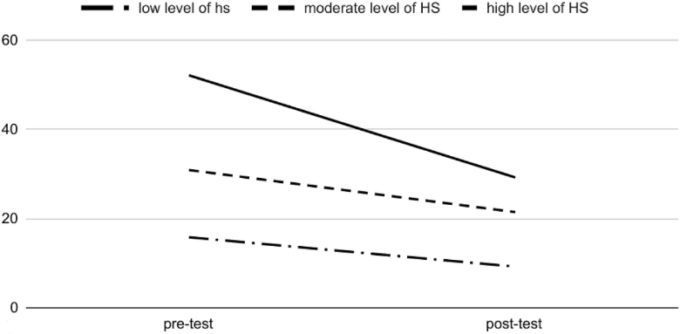
Individuals with low levels of gender essentialism showed lower acceptance of myths about gender-based violence both before participating in the course and after its completion. At the same time, participation in the course was associated with a reduction in the acceptance of these myths among individuals with high and moderate levels of gender essentialism (see Figure 2).
Figure 2. Effect of the course on the level of gender-based violence myth acceptance: gender essentialism as a moderator.
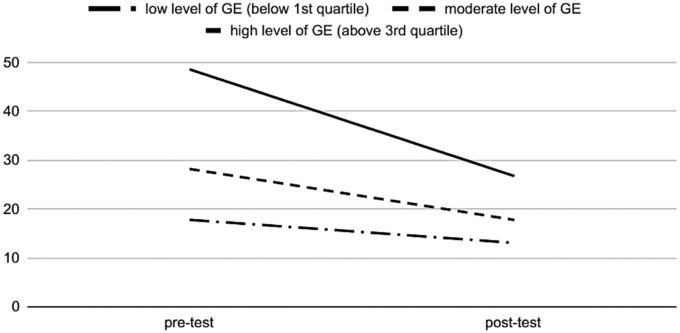
SUMMARY | The findings suggest that the online gender-based violence prevention program may be effective in reducing the acceptance of violence-related myths and increasing participants’ confidence in responding to such situations as bystanders. Importantly, these effects were still evident three months after the course had ended, suggesting that the observed changes were not merely short-lived.
Particularly noteworthy were the findings for individuals with higher levels of hostile sexism and gender essentialism. Contrary to concerns that such beliefs might limit the effectiveness of educational interventions, the greatest reductions in the acceptance of violence-related myths were observed among participants in these groups. In addition, individuals with high levels of hostile sexism showed the largest increase in confidence in their ability to respond to potential situations of violence.
However, it should be noted that the study was conducted on a small sample of students, and the variables assessed were based on participants’ self-reports rather than observations of actual behavior. Despite these limitations, the findings point to the promising potential of online prevention programs as a tool for supporting efforts to address gender-based violence in academic settings.
Photo by Lomb from Adobe Stock
Views: 5