


 News
~ 1 634 words | ~ 11 009 characters | Reading time: 7 minutes
„Climate change is real, but…” – seven arguments that delay action
Climate change is real, but… “other countries should also do something,” “technology will solve the problem for us,” “it is already too late to take effective action.” Beliefs of this kind do not deny the existence of the climate crisis, but they can effectively delay action to protect the climate. Dr. Adrian Wójcik (PSPS Board member; Nicolaus Copernicus University), Dr. Michał Główczewski (PSPS regular member; Nicolaus Copernicus University) and Prof. Taciano Milfont (University of Waikato) developed the first tool to measure climate delayism and identified seven of the most common narratives used to justify delaying climate action.
 Adrian Wójcik
 Michał Główczewski
 Taciano Milfont
INTRODUCTION | The public debate about whether climate change is occurring or not is still ongoing. However, less attention is being paid to directly denying the existence of climate change, while narratives that do not question the problem itself but instead challenge the need for, rationale behind, or effectiveness of taking decisive pro-environmental action are becoming increasingly important. This new form of narrative – climate delayism – includes, among other things, shifting responsibility onto others, the belief that future technologies will solve the problem, emphasizing the costs of climate policies, and climate fatalism. This stance poses a serious challenge to taking effective action to mitigate climate change.
In their research, Dr. Adrian Wójcik, Dr. Michał Główczewski, and Prof. Taciano Milfont developed a tool to measure beliefs related to climate delayism (Climate Delayism Inventory). The researchers also examined whether, as theorized, people who endorse climate delayism do not deny climate change and whether they are aware of the scientific consensus regarding the human impact on climate change. In addition, they sought to measure how climate delayism is related to political views, as well as support for climate policies and pro-environmental behaviors.
HYPOTHESES | It was predicted that the multidimensional structure of the climate delayism scale would be similar across different countries, confirming the cross-cultural validity of the measure. The authors hypothesized that beliefs related to climate delayism would also be present among people who acknowledge the reality of climate change. In addition, it was predicted that higher levels of climate delayism would be associated with a more right-wing political orientation, as well as lower support for pro-environmental policies and less engagement in pro-environmental actions.
STUDY 1 | Study 1 was conducted with two nationally representative samples – in Poland (N = 536) and the United Kingdom (N = 502). It aimed to examine whether the measure developed by the authors accurately captures the forms of climate delayism described in the concept proposed by Lamb et al. (2020). Seven dimensions of climate delayism were distinguished, each containing four statements:
(1) Individualism, e.g., Individuals should take appropriate decisions as consumers to address climate change.
(2) The „free rider”excuse, e.g., If our country adopts policies to reduce emissions, other countries will actively take advantage of us.
(3) Technological optimism, e.g., The development of modern technologies will allow mankind to cope with climate threats.
(4) All talk, little action, e.g., Other countries should follow our example when it comes to combating climate change.
(5) Fossil fuels solutionism, e.g., Fossil fuels are not so bad if you use them wisely and rationally.
(6) Appeal to social justice, e.g., The poorest will become victims of the policies introduced as part of the combat against climate change.
(7) Doomism, e.g., It is already too late to try to mitigate climate change.
In addition, the researchers examined the relationship between climate delayism and variables like:
Anthropogenic climate change scepticism – measured using the question: Which of the following comes closest to your opinion on the causes of climate change? Responses were given on a scale on which lower values indicated greater scepticism about the anthropogenic nature of climate change, with 0 – there is no such thing as climate change – 5 – entirely caused by human activity.
Perceived climate science consensus – easured with the question: To the best of your knowledge, what percentage of climate scientists think that human-caused climate change is happening? Responses were given on a scale from 0% to 100%.
Political orientation – measured using the question: In political matters, people sometimes talk about the left and the right. How would you place your political views on this scale, generally speaking? Responses were given on a scale where 1 indicated left-wing views and 7 indicated right-wing views.
RESULTS | The statistical analysis confirmed the validity of the measure’s structure and its fit in both the Polish and British samples. An analysis was also conducted to examine whether the level of support for particular climate delayism narratives differed from the neutral level (response 4 – neither agree nor disagree).
The results showed that, among both Polish and British participants, two dimensions of climate delayism were above the neutral level – individualism and technological optimism (see Figure 1). Poles, however, were more likely than Britons to endorse beliefs related to social justice and treating fossil fuels as part of the solution to the climate problem.
In contrast, „all talk, little action” and climate fatalism scored significantly below the neutral point in both Poland and the United Kingdom. This means that participants generally disagreed with these beliefs. British participants also disagreed with the view that their country’s efforts to reduce emissions would be exploited by other countries to its disadvantage (the „free rider” excuse).
Figure 1. Comparison of mean levels of support for individual dimensions of climate delayism in the countries studied.
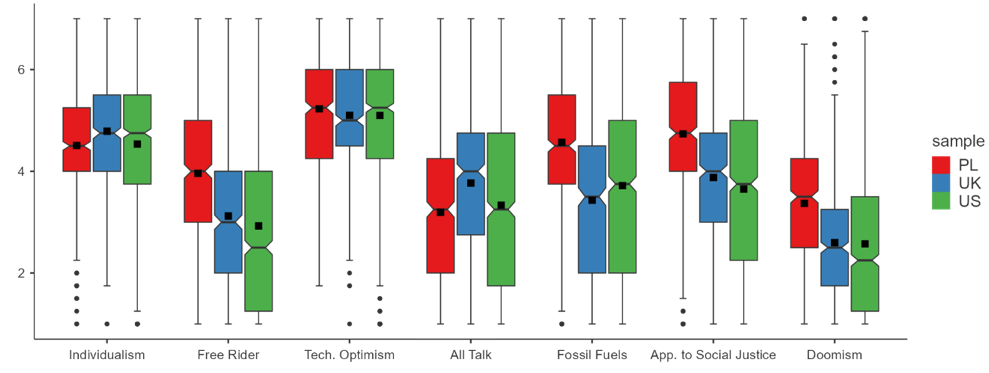
As predicted, in most dimensions, greater support for climate delayism was associated with more right-wing political views. The exception, both in Poland and the United Kingdom, was individualism, which was not related to political orientation. In the United Kingdom, technological optimism was also unrelated to political views.
A similar pattern of associations was observed for scepticism about anthropogenic climate change and perceived scientific consensus regarding its causes. In Poland, individualism was not related to either of these variables. Technological optimism, however, was associated with a stronger belief in the significant role of humans in causing climate change and with a higher perceived scientific consensus on this issue. In the United Kingdom, technological optimism was not related to scepticism about anthropogenic climate change, but it was associated with a higher perceived scientific consensus. The remaining dimensions of climate delayism were associated with greater scepticism about the anthropogenic nature of climate change and lower perceptions of scientific consensus. These findings show that acknowledging the significant role of humans in climate change and being aware of the scientific consensus do not preclude simultaneously endorsing beliefs related to climate delayism.
STUDY 2 | Study 2 was conducted among residents of the United States (N = 1,496). It aimed to examine whether the structure of the scale could be replicated in a different cultural context and to analyse the relationship between climate delayism and measures such as:
Political orientation – measured using two questions: In political matters, people sometimes talk about the left/liberals and the right/conservatives. How would you place your political views on this scale, generally speaking? Responses were given on a scale where 1 indicated left-wing views/very liberal and 7 indicated right-wing views/very conservative.
Support for climate policies – measured using 9 items from the measure developed by Stanley et al. (2025), e.g., I support raising carbon taxes on fossil fuels.
Environmental citizenship intentions – assessed using 12 items developed by Bain et al. (2012), e.g., I will give money to an environmental group.
Personal sphere behavioural intentions – assessed using 12 items developed by Bain et al. (2012), e.g., I will reduce car travel.
RESULTS | The analysis of the data from the United States confirmed the scale structure obtained in Study 1. As in the studies conducted in Poland and the United Kingdom, participants most strongly endorsed climate delayism beliefs in the dimensions of individualism and technological optimism (see Figure 1).
Analyses predicting support for climate policies and individual and environmental citizenship engagement showed that participants with more left-wing political views were more likely to report support for these policies and greater willingness to engage.
Furthermore, similarly to Study 1, the results suggest that narratives based on individualism and technological optimism may rely on different psychological mechanisms than the other dimensions of climate delayism. Higher levels of individualism were associated with greater engagement across all three areas of pro-environmental action examined. Technological optimism, in turn, was associated with greater support for climate policies.
A different pattern of associations was found for beliefs concerning the role of fossil fuels, which were associated with lower support for systemic environmental policies and less frequent engagement in pro-environmental behaviors. Additionally, the belief that the climate action currently being taken is sufficient (all talk, little action) was associated with lower levels of both personal and environmental citizenship engagement in pro-environmental actions.
SUMMARY | The studies presented indicate that a contemporary obstacle to climate action is not only the classic denial of climate change but also more subtle narratives that justify delaying action. The results show that beliefs related to climate delayism are socially widespread and can coexist with acknowledging the reality of the climate crisis. Moreover, they are associated with general political orientation, rather than exclusively with attitudes toward climate change. This means that effective climate communication should address not only climate change denial but also narratives that undermine the need for decisive action.
The findings concerning individualism and technological optimism were particularly interesting. In contrast to the other dimensions of climate delayism, they were associated with greater support for climate policies and pro-environmental actions. However, these results should be interpreted with caution. On the one hand, they may indicate a greater willingness to engage in climate action; on the other hand, previous research suggests that focusing on individual and technological solutions may weaken support for systemic change. These findings contribute to the debate on shifting responsibility for addressing climate change onto individuals rather than institutions and economic actors.

Photo by deagreez from Adobe Stock
Views: 5