

'/%3E%3C/svg%3E)
 News
News
~ 1 442 words| ~ 9 661 characters | Reading time: 7 minutes
Immoral but competent? Fraud and harassment in academia
Fraud and sexual harassment remain present in the academic environment. Despite structural measures being taken, the way these phenomena are perceived by the academic community plays a key role in limiting them. These evaluations have been examined in research conducted by Katarzyna Miazek
(PSPS junior member), Dr. Konrad Bocian (PSPS regular member) and Dr. Katarzyna Myślińska Szarek from SWPS University.
 Katarzyna Miazek
 Kondrad Bocian
 Katarzyna Myślińska-Szarek
INTRODUCTION | Periodically, the academic world is shaken by reports of researchers falsifying their data, often over many years. However, academia is not only confronted with research fraud but also with cases of sexual harassment. Although the number of complaints in this area varies over time, it is widely known that many such incidents go unreported. Despite the existence of procedures intended to prevent fraud and sexual harassment and to punish perpetrators, they are not always effectively enforced. This may stem from the way these behaviors influence perceptions of the perpetrators’ morality and competence.
In their research, Katarzyna Miazek, Dr. Konrad Bocian, and Dr. Katarzyna Myślińska Szarek drew on the Moral Primacy Model, according to which evaluations of others are based primarily on their morality and competence. Morality shapes the tendency to approach or avoid a given person, whereas the capacity to cause harm may paradoxically be associated with higher competence. An important factor in these evaluations is also gender—statistics indicate a predominance of women among victims and men among perpetrators of sexual violence, alongside a tendency to morally favor those who are similar to oneself.
HYPOTHESES | It was predicted that sexual harassment would be judged as more immoral and more harmful than fraud. It was also assumed that women and men would differ in their moral evaluations of perpetrators of sexual harassment. The authors further hypothesized that perpetrators of harassment might be perceived as competent despite their immoral behavior, particularly in the academic context. Additionally, it was expected that penalties imposed on perpetrators of sexual harassment would be more severe than those applied to individuals engaging in fraud.
EXPERIMENT 1 | The study was conducted among residents of the United Kingdom (N = 769). Participants read a fictitious newspaper article about a well-known businessman or scientist—Gregory Inma, who allegedly either falsified data to obtain a research grant or engaged in the harassment of women. The perpetrator denied the allegations, and an investigation was ongoing. Participants were then asked to evaluate the perpetrator’s moral character, his competence, and to indicate an appropriate penalty for his actions.
Moral character judgments -measured using 5 items adapted from the scale developed by Abele et al. (2016), e.g., Gregory Inma is trustworthy
Competence judgments – mierzono za pomocą 5 pozycji również zaadaptowanych z narzędzia autorstwa Abele et al. (2016), e.g., Gregory Inma is intelligent.
Punishment judgments – assessed using 7 items, e.g., Gregory Inma should be suspended from his job.
RESULTS | Moral character judgments. Contrary to the hypothesis, the alleged perpetrator of sexual harassment was judged as more moral than the alleged fraudster. However, in line with predictions, men evaluated the perpetrator of sexual harassment as more moral than women did. In the case of the alleged fraudster, differences between women’s and men’s evaluations were not significant.
Competence judgments. As expected, the alleged perpetrator of sexual harassment was evaluated as more competent than the alleged fraudster. Moreover, men but not women, perceived the perpetrator of sexual harassment as more competent than the fraudster, and this effect occurred only in the academic context.
Punishment judgments. In the case of the alleged perpetrator of sexual harassment, men called for more lenient penalties than women did. No differences were found between women’s and men’s evaluations regarding punishment for the alleged fraudster.
EXPERIMENT 2 | Study 2 was conducted among residents of the United States (N = 1496). Unlike Experiment 1, in which the described individual was merely accused of fraud or sexual harassment, Study 2 introduced an additional condition that clearly indicated the perpetrator’s guilt. As before, participants read a fictitious newspaper article about Gregory Inma, who:
(1) was a businessman or a scientist,
(2) was either suspected of the behavior or explicitly identified as its perpetrator,
(3) had engaged in either fraud or sexual harassment.
Subsequently, as in Experiment 1, participants evaluated the perpetrator’s moral character, his competence, and the appropriateness of the punishment. Additionally, perceived harm was measured to test the assumption that sexual harassment should be seen as more harmful than fraud.
Harm – was measured with a single item: How harmful (i.e., involving physical and/or emotional suffering) were the actions of Gregory Inma?
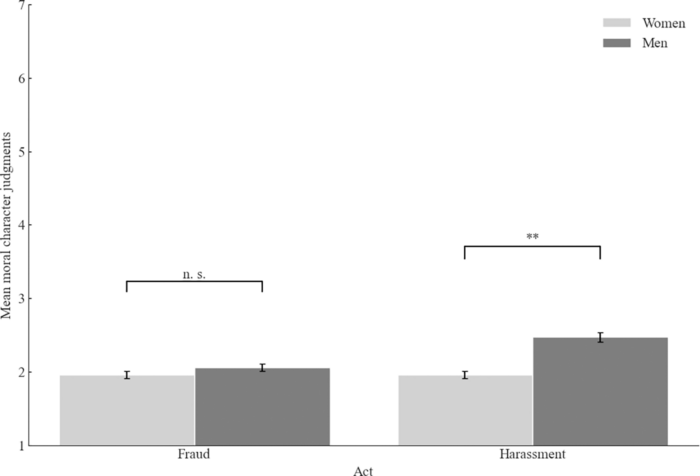
RESULTS | Moral character judgments. As expected, an individual merely suspected of a given act was evaluated as more moral than an individual clearly identified as guilty. As in Study 1, men evaluated the perpetrator of sexual harassment as more moral than women did (see Figure 1).
Competence judgments. In the academic context, the perpetrator of sexual harassment was evaluated as more competent than the fraudster, replicating the findings of Study 1. However, a different pattern emerged in the business context—the perpetrator of sexual harassment was evaluated as less competent than the fraudster.
Punishment judgments. As in Study 1, women called for more severe penalties for perpetrators of sexual harassment than men did. No differences between women and men were found in the severity of punishment evaluations when they concerned fraud. Moreover, when the perpetrator was merely accused of sexual harassment, participants called for more lenient penalties than in the case of an accusation of fraud. This difference disappeared, however, when both perpetrators were clearly identified as guilty.
Harm. As predicted, sexual harassment was evaluated as more harmful than fraud. Regardless of the type of act, women rated the level of harm inflicted as higher than men did. Additionally, sexual harassment was perceived as more harmful when it was proven than when it was only suspected.
Figure 1. Moral character judgments as a function of participants’ gender and act.
In the next two studies, the authors sought to explain why perpetrators of sexual harassment are evaluated differently by women and men in terms of moral character and why these differences emerge between the academic and business contexts in competence judgments.
EXPERIMENT 3A | Study 3a was conducted among residents of the United States (N = 906), who read the same fictitious articles about Gregory Inma as in Study 2. Moral character judgments were assessed using the same measure as in Studies 1–2. In addition, moral rationalization was measured as a potential psychological mechanism explaining differences in moral character evaluations.
Moral rationalization – measured using 5 items adapted from the scale by Bhattacharjee et al. (2013), in the fraud condition, e.g., People should not be at fault for lying on their grant reports because the system is too complicated; ; in the sexual harassment condition, e.g., People should not be at fault for sexual harassment because the social norms are too complicated.
RESULTS | Once again, men perceived the perpetrator of sexual harassment as more moral than women did. Additionally, men engaged in moral rationalization to a greater extent than women. However, this mechanism did not explain the differences in evaluations of the perpetrator’s moral character.
EXPERIMENT 3B | Study 3b was conducted among residents of the United States (N = 496), who again read the same fictitious articles about Gregory Inma as in Study 2. In this study, participants were asked to evaluate the competence of the man described in the article using the same measure as in Studies 1–2. Participants also responded to statements concerning moral decoupling as a potential mechanism explaining competence evaluations.
Moral decoupling – measured using 3 items adapted from the scale by Bhattacharjee et al. (2013), e.g., Reports of wrongdoing should not affect our view of Gregory Inma’s achievements.
RESULTS | As in the previous studies, in the academic context, the perpetrator of sexual harassment was evaluated as more competent than the fraudster. Moreover, in this same context, the level of moral decoupling was higher for the perpetrator of sexual harassment, whereas no differences were observed in the business context. This finding may help explain the differing perceptions of perpetrators of sexual harassment and fraudsters across the two settings. The effect was observed among both men and women, as neither the type of act nor the context interacted with participants’ gender.
SUMMARY | The presented experimental studies consistently show that men evaluate perpetrators of sexual harassment as more moral and call for more lenient penalties for them than women do. At the same time, moral rationalization did not explain the observed gender differences in evaluations of perpetrators’ moral character.
Moreover, in the academic context, but not in the business context, the perpetrator of sexual harassment was evaluated as more competent than the fraudster. This difference was driven by the process of moral decoupling, which allowed participants, regardless of gender, to separate competence evaluations from moral judgments of the perpetrator.

Image by deagreez from Adobe Stock
Views: 22