

'/%3E%3C/svg%3E)
 News
News
~ 1 432 words | ~ 9 661 characters | Reading time: 7 minutes
When threat unites: The role of coalitions and group identity in the fight for women’s rights
Changes to reproductive rights in Poland and the United States became a catalyst for mass protests. These events drew attention to the role of subjective feelings of threat as a factor mobilizing people to engage in social action, as well as to the importance of different forms of intergroup cooperation in this process. In a series of five studies, Dr. Anna Potoczek (PSPS Board member; University of Warsaw) and Prof. Marcin Bukowski (PSPS regular member; Jagiellonian University), together with their team, examined the role of coalitions and recategorization as mechanisms mediating the relationship between personal threat and intentions to engage in collective action in defense of reproductive rights.


INTRODUCTION | When an individual’s sense of control and autonomy is threatened because of their group membership (e.g., gender), and changing that group is either impossible or undesirable, this may strengthen motivation to act in defense of the group’s rights. However, an important question arises: can personal threat also foster intergroup cooperation and mobilize people to engage in collective action, as was explored by Dr. Anna Potoczek and Prof. Marcin Bukowski together with their research team.
In the context of restrictions on reproductive rights, women experience a direct threat, whereas for men the threat may be more indirect, stemming rather from solidarity or broader beliefs about human rights. As allies, men can support women’s collective action by forming coalitions, that is, by engaging in joint action while maintaining distinct group identities. This form of cooperation may increase public support for protests while also strengthening gender equality norms and promoting women’s well-being.
At the same time, women and LGBTIQ+ individuals belong to socially disadvantaged groups, which may foster a different mechanism of cooperation. In their case, an important role may be played by recategorization, that is, identifying with a single superordinate category that encompasses the identities of both groups. Social threats can blur boundaries between groups, encouraging their members to perceive themselves as part of a common group of “oppressed people.” As a result, perceiving a shared fate may promote mutual support between women and LGBTIQ+ individuals and strengthen their willingness to engage in joint action.
HYPOTHESES | The authors predicted that higher levels of perceived personal threat related to abortion restrictions would be associated with greater willingness to engage in collective action in defense of reproductive rights. They also hypothesized that perceptions of coalition-based cooperation between women and men would mediate the relationship between personal threat and intentions to engage in collective action. In the case of cooperation between women and LGBTIQ+ individuals, both coalition formation and recategorization were expected to serve as mediators.
STUDY 1 | The aim of Study 1 was to provide an initial test of the proposed model in a diverse sample, including individuals with different gender identities. The study was conducted in Poland (N = 310) during the ongoing Women’s Strike protests. The sample consisted of 231 women, 71 men, and 8 individuals who indicated another gender identity or did not answer the question. Participants completed measures assessing the following constructs:
Personal threat induced by abortion restrictions – measured with 4 items, e.g., I feel threatened by abortion restrictions.
Coalition between different groups – assessed with 3 items adapted from Bukowski et al. (2024), e.g., Women and men in Poland should cooperate in fighting against the restrictions of the abortion law.
Recategorization – also measured with 3 items adapted from Bukowski et al. (2024), e.g., Women and men in Poland share a common fate.
Collective action intentions – willingness to participate in collective action against abortion restrictions, assessed with 4 items, e.g., If possible, I will take part in the protest against the abortion ban.
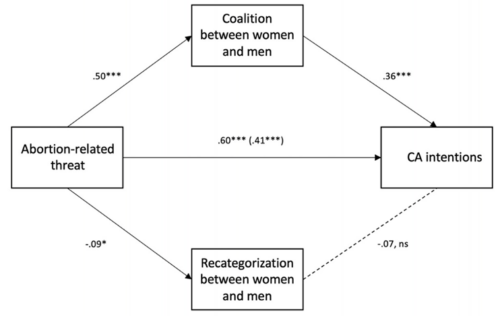
RESULTS | Consistent with the hypotheses, personal threat caused by abortion restrictions was associated with greater willingness to engage in collective action in defense of reproductive rights. Coalition between women and men, but not recategorization, served as a mediating variable in the relationship between feelings of threat and collective action intentions (see Figure 1).
Figure 1. Mediation analysis of the relationship between personal threat caused by abortion restrictions and collective action intentions in the Polish sample.
STUDIES 2A-B | The next two studies tested the assumptions of the model in samples composed of participants with homogeneous gender identities who supported the ongoing Women’s Strike movement in Poland. Accordingly, Study 2A was conducted among women (N = 462), examining coalition and recategorization in relation to men and LGBTIQ+ individuals. Study 2B, in turn, was conducted among men (N = 255), focusing on coalition and recategorization in relation to women. Both Studies 2A and 2B were conducted in Poland and used the same measures as Study 1, adapted to the specific context under investigation.
RESULTS | STUDY 2A | Similarly to Study 1, among women, coalition with men, but not recategorization, served as a mediating variable in the relationship between personal feelings of threat caused by abortion restrictions and willingness to engage in collective action in defense of reproductive rights. In contrast, in the case of cooperation with LGBTIQ+ individuals, both coalition and recategorization functioned as mediators—higher levels of perceived threat were associated with greater willingness to engage in collective action through both of these mechanisms (see Figure 2).
RESULTS | STUDY 2B | Analysis of the data collected among men replicated the pattern of results obtained in Study 1. Coalition with women, rather than recategorization with them, served as the mediating variable between personal feelings of threat caused by abortion restrictions and willingness to engage in collective action in defense of reproductive rights.
Figure 2. Mediation analysis of the relationship between personal threat caused by abortion restrictions and collective action intentions among women in Poland.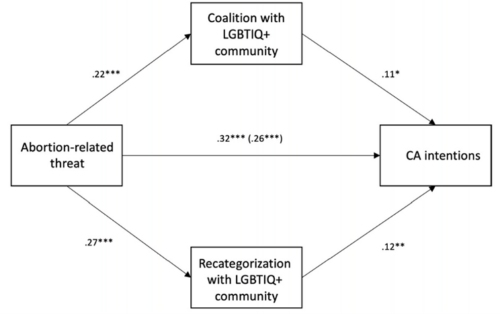
STUDIES 3A-B | The studies conducted in Poland were replicated in the American context, following the same research design. Studies 3A–3B were carried out in the United States in June 2022, shortly after the outbreak of mass protests against the anticipated Supreme Court decision to overturn Roe v. Wade—the landmark 1973 ruling that established the constitutional right to abortion.
Study 3A involved women (N = 289) and examined coalition and recategorization in relation to men and LGBTIQ+ individuals. Study 3B was conducted among men (N = 333), focusing on coalition and recategorization with women. In both studies, only individuals who supported the protests participated.
RESULTS | STUDY 3A | Among the sample of women from the United States, neither recategorization nor coalition with men mediated the relationship between personal threat caused by abortion restrictions and willingness to engage in collective action in defense of reproductive rights. In turn, with regard to LGBTIQ+ individuals, only coalition with this group mediated the association between personal threat and collective action intentions.
RESULTS | STUDY 3B | The results of the analyses conducted among men in the United States replicated the pattern obtained in the Polish context. Only coalition, but not coalition, with women emerged as a significant mediator in the relationship between personal threat caused by abortion restrictions and willingness to engage in collective action in defense of reproductive rights.
SUMMARY | The five studies consistently demonstrate that perceived personal threat resulting from restrictions on abortion rights plays a key role in mobilizing people to engage in collective action. The importance of different forms of intergroup cooperation, which acted as mediators between feelings of threat and action, turned out to depend on the sociocultural context.
In Poland, where the feminist movement is relatively less established, coalitions between women and men foster intentions to engage in collective action, likely because of their strategic value in achieving collective goals. In the United States, where feminist movements have a longer and stronger tradition, this relationship was not observed—women may perceive collective action as achievable without men’s support. At the same time, in both countries, cooperation between women and LGBTIQ+ individuals supported collective mobilization, although in the United States, unlike in Poland, their role was limited mainly to coalition-based forms of cooperation rather than recategorization.
From the perspective of privileged groups (men) from both countries, it was willingness to form coalitions—rather than recategorization—that explained the relationship between feelings of threat and engagement in actions supporting reproductive rights. This suggests that cooperation based on maintaining distinct group identities may be more effective in mobilizing collective action than striving to create a single, shared identity. Coalitions appear particularly important because they enable joint action while simultaneously acknowledging differences between groups, thereby fostering cooperation grounded in equality, but at the same time, more strategic.
Photo by Roman Biernacki from Pexels
Views: 14